As soon as you begin looking into rhinoplasty, you will inevitably encounter these words – open and closed. People tend to think that this is just a question of a surgeon's personal preference; however, it all boils down to what needs to be performed in your particular case, and these approaches have some real differences.
In this guide, we are going to talk about what open and closed rhinoplasty techniques actually entail, what their differences are and what affects the choice of one or the other. Of course, as in any kind of surgery, a good consultation can solve all your doubts.
Contents
-
The Core Difference: How Access Is Made
-
What Closed Rhinoplasty Involves
-
What Open Rhinoplasty Involves
-
Why Surgeons Choose One Over the Other
-
Scarring: What to Actually Expect
-
Recovery Differences
-
Which Cases Typically Need an Open Approach
-
Which Cases Can Often Use a Closed Approach
-
Malaysian Patient Considerations
-
Risks and Safety Considerations
-
Cost Factors to Understand
-
Conclusion & Frequently Asked Questions
The Core Difference: How Access Is Made
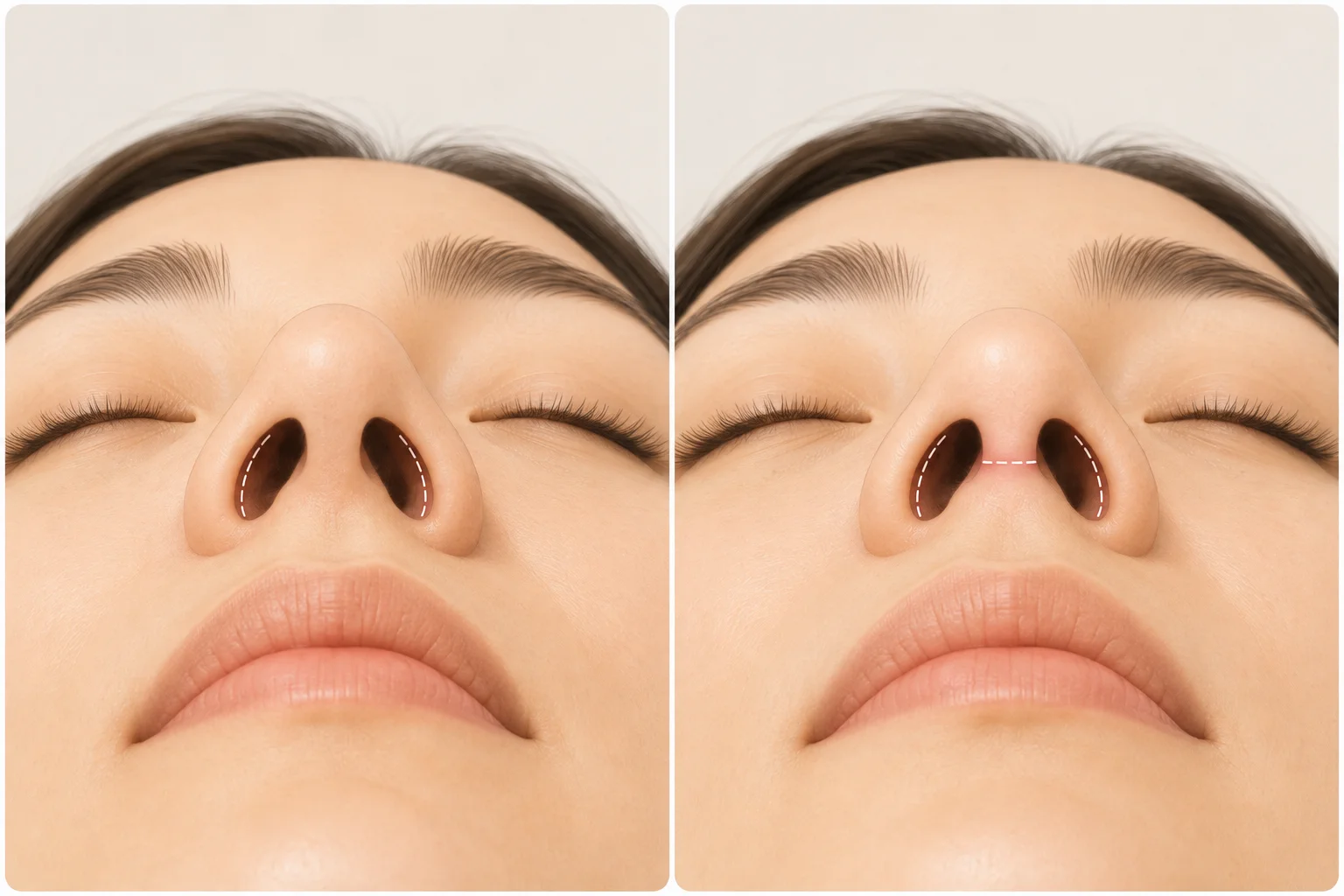
The key difference between open and closed rhinoplasty is that both surgeries differ in the technique used to gain access to the inner part of the nose that will be reshaped.
Closed rhinoplasty does not involve any external cuts, as they all are done inside the nostrils. In the case of an open rhinoplasty, the surgeon creates an additional incision on the columella, which is the thin piece of tissue connecting the nostrils. It provides access to the inner parts of the nose that can be reshaped. This one difference affects almost every step of the two procedures.
What Closed Rhinoplasty Involves
Closed rhinoplasty, which is also referred to as endonasal rhinoplasty, involves only incisions that are concealed within the nose.
Important things to know about closed rhinoplasty:
-
There are no external and visible incisions because all access during surgery is internal
-
The surgeon performs his/her job with a narrower field of vision, using experience to reshape the structures internally
-
Typically considered a type of shorter procedure in those cases where extensive restructuring of the nose is not necessary
-
Typically causes less swelling because of a narrower surgical access
What Open Rhinoplasty Involves
With an open rhinoplasty procedure, there is one more incision made on the columella for lifting of the skin in order to visualize the underlying cartilage and bone structure.
The main characteristics of open rhinoplasty include:
-
Direct visualization of the nasal structures that is beneficial for most surgeons when working with complex cases
-
External incision is rather small and placed in such a way that it becomes practically invisible after healing
-
Often preferred when dealing with complex cases, such as structural rebuilding, revision surgery, or when exact placement of the cartilage graft is required
-
Might cause a bit more swelling due to increased exposure of the nose, especially its tip
|
Factor |
Closed Rhinoplasty |
Open Rhinoplasty |
|
Incision location |
Entirely inside the nostrils |
Inside nostrils plus small external incision across the columella |
|
Visible scarring |
None externally |
Small scar, generally well-hidden once healed |
|
Surgical visibility |
More limited, relies on surgeon experience |
Direct, unobstructed view of nasal structures |
|
Best suited for |
Less complex reshaping |
More complex or structural cases |
|
Typical tip swelling |
Generally less initially |
Can be somewhat more initially |
|
Revision surgery suitability |
Less commonly used for complex revisions |
Often preferred for revision cases |
|
Procedure time |
Often shorter for simpler cases |
Can be longer, given more extensive access |
Why Surgeons Choose One Over the Other
It is not whether one approach is necessarily better than another, but whether the surgical approach chosen is best suited to the particular reshaping needed by the individual patient. The surgeon may take into account such factors as:
- How complicated the case is - sometimes a more complex procedure is aided by the direct visualization that is possible with an open approach
- Whether this is the first time the surgery is done or a revision - sometimes a revision requires a clearer view, especially since there is scarring
- The particular aims of the surgery - certain types of reshaping, especially tip shaping, are better done under direct visualization
- The particular training and experience of the surgeon - some surgeons have had a lot of experience doing a wide variety of surgeries using closed techniques, while other surgeons prefer to use open techniques
Scarring: What to Actually Expect
This is one of the most frequently raised concerns by patients, and it needs to be discussed. In closed rhinoplasty, there will be no scar at all as all incisions are made internally. In open rhinoplasty, there will be a scar that crosses the columella; however, the incision is placed in the natural skin crease and for the vast majority of patients, it matures into almost unnoticeable scar even up close.

Visible scarring should not be the decisive factor when choosing the type of surgery as many other factors weigh much more.
Recovery Differences
Recovery following both procedures is quite alike in terms of overall recovery process, although there are certain distinctions that should be noted.
Closed rhinoplasty recovery includes the following:
-
Slight reduction in initial swelling, especially in the tip area, due to the less extent of exposure of the area
-
The process of recovery, which is considered to be somewhat easier during the first week
-
Recovery following open rhinoplasty includes the following:
-
Slight increase in the initial swelling of the tip area, due to the increased access to the nose area
-
Similar period of recovery despite the additional incision in the nose area
In both cases the results will appear within many months, no matter which procedure is chosen.
Which Cases Typically Need an Open Approach |
What Cases Can Often Take the Closed Approach |
|
|
How Technique Choice Affects Specific Nasal Areas
Apart from the general case complexity, there are certain areas of the nose itself that affect the choice of a surgical technique.
-
An open approach would come in handy for nasal tip surgery thanks to visualization. It becomes especially important when it comes to cartilage sculpting and grafting required to create a refined tip, since it is one of the most common features of Asian rhinoplasty.
-
When the changes need to be done only to the bridge and not to the tip, a closed technique can sometimes be used.
-
However, if the procedure involves complex changes to both the bridge and the tip of the nose, the chances are that an open approach will be applied due to a better overall view of the area.
-
All of this makes the proper technique selection highly individual depending on what the patient's nose requires.
Malaysian Patient Considerations
Climate and swelling
The warm, humid weather in Malaysia could mean that swelling of the face will be even more pronounced during the early stages of healing, regardless of the method being employed. Maintaining cool surroundings and adhering to the advice of your surgeon regarding post-surgery care can help you deal with the situation.
Work and social arrangements
As the swelling of the nose and the splint would be more obvious for the first one to two weeks, many Malaysians opt for surgery when there is little activity at work or around festive periods when a temporary period of lower public exposure is easier to arrange.
Sun protection during healing
Because of the constant and intense sun exposure in Malaysia, sun protection becomes an essential part of rhinoplasty recovery.
Risks and Safety Considerations
Open and closed rhinoplasty are both surgery and have common risks associated with surgery, which include infection, bleeding, and problems with anesthesia. In addition to common surgical risks, open rhinoplasty involves a small incision made externally, but complications that may arise due to this particular cut are rare if the procedure is performed by an experienced doctor. Both types of rhinoplasty are relatively safe procedures if performed by a qualified plastic surgeon.
Cost Factors to Understand
The price variance of open rhinoplasty vs closed rhinoplasty has less to do with the method itself and more to do with the complexity of the particular case. An elaborate case that requires open surgery and cartilage grafting will be more expensive compared to a simple case of closed rhinoplasty. However, this is based on how much needs to be done to achieve your desired results. For a detailed quotation for your case, you need a thorough consultation.
Conclusion
Open and closed rhinoplasty are two equally well-proven and efficient surgical methods; it is not one that is better than another but rather the one that is more suitable depending on the specifics of your individual case. Knowing what distinguishes them beyond "with scar or without" will help you discuss your options more efficiently with the surgeon.
Frequently Asked Questions
Will I be able to see the scar from open rhinoplasty?
In most cases, the healing of the small columella incision becomes almost impossible to see when the wound has fully healed, usually within a few months to a year post-surgery.
Is closed rhinoplasty less effective than open rhinoplasty?
That does not have to be the case – closed rhinoplasty will deliver great results in certain cases, depending on the particular case. It just comes down to the surgical access method and the complexity of the particular reshaping procedure.
Which technique has a faster recovery?
There is a general similarity between recovery in the two techniques, although closed rhinoplasty may sometimes feature less swelling of the tip immediately post-surgery due to limited access.
Can I choose which technique I want, or does the surgeon decide?
Your preference will certainly be taken into account, but the particular technique that will best suit your case will depend on the particular needs of the case. Your surgeon will let you know why he/she thinks that way.
Is open rhinoplasty always used for revision surgery?
The technique is favored by surgeons in the case of revisions due to complexity of the anatomy of revision cases.
What determines what procedure will be best for me?
That is done by way of an initial consultation and physical examination, during which your surgeon will assess your particular anatomy and needs.