
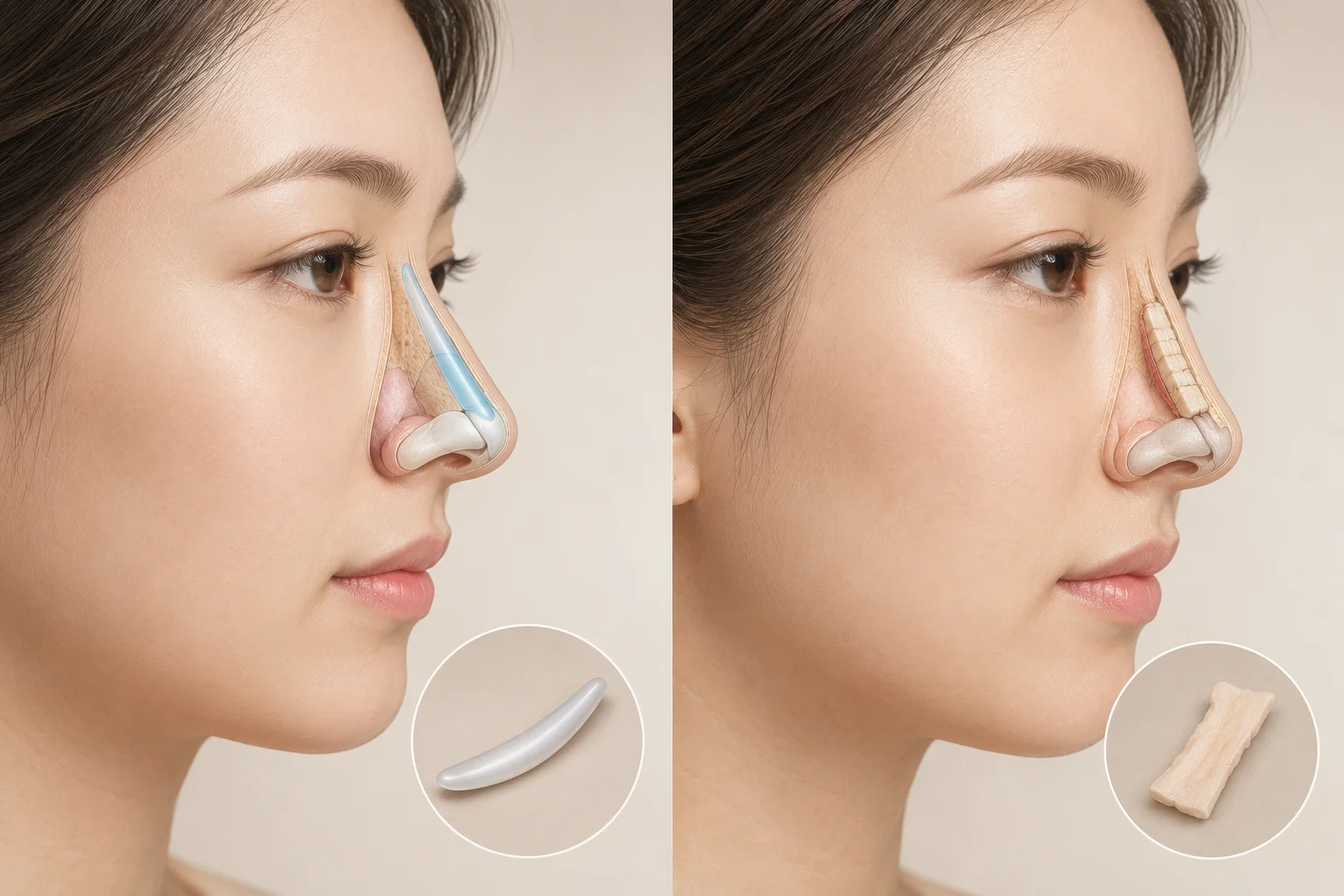
It should be understood that Asian rhinoplasty is an independent field of nose surgery that incorporates nasal features that are common to the patients who are Asians – for example, thinness of the nasal skin, a flat or low nose bridge, and less stiff nasal cartilage than what is seen in the case of Western rhinoplasty.
The implant vs. cartilage issue arises due to the need for structure and height in most cases of Asian rhinoplasty, which makes this surgical procedure different from Western rhinoplasty, when the nose needs to be reduced.
Implant or cartilage is selected based on the fact that some substance is needed to build up the nasal bridge; thus, the surgeon chooses either artificial implant or cartilage taken from the body of the patient. Both of these methods are commonly employed, yet they have completely different features, and you should understand these differences prior to the consultation.
Contents
-
Why Asian Rhinoplasty Often Differs From Western Rhinoplasty
-
What Implant Rhinoplasty Involves
-
What Cartilage Grafting Involves
-
Where Cartilage Is Typically Sourced From
-
Who Tends to Suit Implants
-
Who Tends to Suit Cartilage Grafting
-
Can the Two Approaches Be Combined
-
Recovery Differences
-
Cost Factors to Understand
-
Conclusion & Frequently Asked Questions
Why Asian Rhinoplasty Often Differs From Western Rhinoplasty
Most rhinoplasties in the Western world aim to reduce a large bridge and/or resize an oversized nose. But Asian rhinoplasty is often characterized by the reverse procedure – the addition of height and definition to the bridge of the nose, refinement of the nasal tip, and other related tasks.
This basic difference between the two types of rhinoplasty is precisely the reason why the material chosen to construct the nose - either implant or cartilage - is so important for Asian rhinoplasty but often not so relevant for rhinoplasties focused on reduction.
What Implant Rhinoplasty Involves
Implant rhinoplasty refers to the use of artificial materials, usually silicone or Gore-Tex (ePTFE) that is used for shaping the bridge of the nose.
Characteristics of implant rhinoplasty:
-
Pre-formed in different shapes and sizes; some implants can be modified during surgery
-
In general, shorter surgery time than using cartilage taken from a separate donor area
-
No additional donor site required for surgery as no cartilage from another part of the body is taken
-
Carries a small but real long-term risk of implant-related complications, including infection, shifting, or in some cases, the implant becoming visible or palpable under thinner nasal skin over time
What Cartilage Grafting Involves
Cartilage grafting, also known as autologous grafting, involves the use of the patient's cartilage, taken from other parts of the body and fashioned for structural creation within the nose.
Key considerations of cartilage grafting:
-
Takes advantage of using your own body tissue, which tends to carry less of a chance of rejection or being identified as a foreign substance over the long run as compared to a synthetic implant
-
Involves an extra incision point to retrieve the cartilage, thus adding another region of the body to the surgical process
-
Tends to blend more naturally with existing tissues, as it is a living tissue and not a synthetic product
-
Limitation may exist in terms of how much cartilage is readily available
Where Cartilage Is Typically Sourced From
In cases where cartilage grafting is to be done, the material used may come from any of these common sources:
|
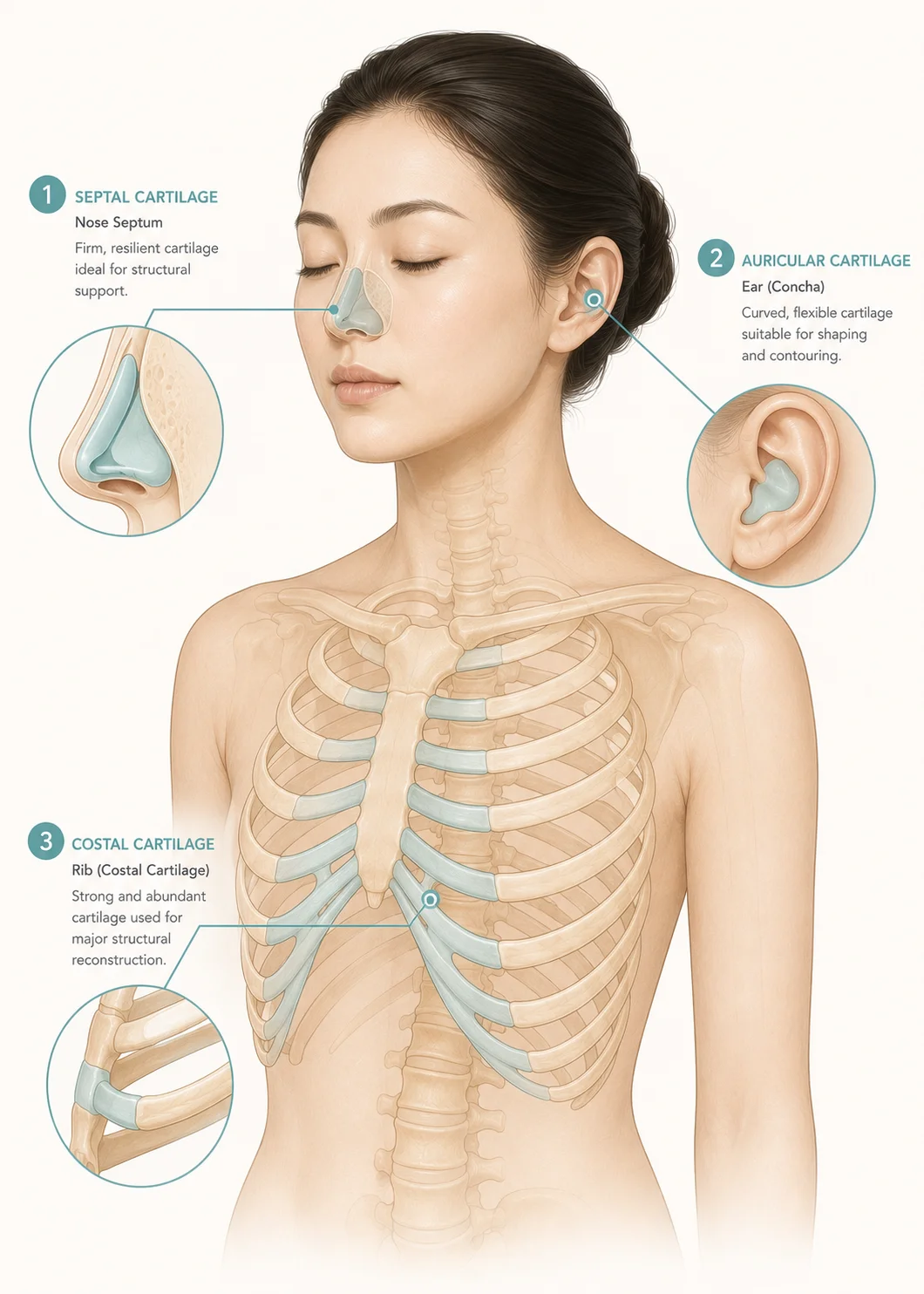
This decision will be dependent on the volume of material that is needed and whether there is enough cartilage in the patient's septum.
|
Factor |
Implant |
Cartilage Grafting |
|
Material source |
Synthetic (silicone or Gore-Tex) |
Patient's own tissue (septum, ear, or rib) |
|
Additional surgical site |
Not required |
Required, depending on cartilage source |
|
Surgical time |
Generally shorter |
Generally longer, due to harvesting |
|
Long-term integration |
Remains a foreign material in the body |
Generally integrates more naturally over time |
|
Risk of visibility/palpability over time |
Present, particularly with thin nasal skin |
Lower, given it's living tissue |
|
Amount of material available |
Not limited by the body's own supply |
Limited by how much cartilage can be safely harvested |
Who Tends to Suit Implants
Implants can be a good choice for those people who:
-
Possess enough nasal skin thickness in order to minimize the chances of showing any edges of implants
-
Want to prevent the need for an extra harvesting point as well as the recovery process
-
Would like to choose something which is standardized and preformed
-
Realize and understand what a permanent synthetic material in their noses entails
Who Tends to Suit Cartilage Grafting
Cartilage grafts may work better for those who:
-
Do not wish to use any artificial substance inside their nose, rather preferring to have something from their own body
-
Have thin skin on their nose, as cartilage would integrate more naturally and minimize the risks related to implants
-
Are willing to spend more time during the surgery and have another donor site in the procedure
-
Require some medium quantity of structural tissue which can be taken from septum or ear cartilage
Can the Two Approaches Be Combined
Yes, it is indeed common practice that surgeons will utilize both techniques in the same rhinoplasty surgery by using cartilage grafts for some areas like the tip of the nose while using implants for other areas like the bridge of the nose, or vice versa. This technique allows the surgeon to choose which technique works best for specific parts of the nose, rather than choosing just one technique for the whole procedure.
Recovery Differences
The recovery process from both implant and cartilage rhinoplasty operations is generally similar, although there may be certain things that are unique about cartilage grafting recovery procedure.
|
Things to be aware of during the general recovery period include: |
|
Long-Term Considerations and Risks
Common risks of surgery that apply to both procedures include infections, bleeding, and complications associated with anaesthesia. Implants present a certain risk in the long term due to the presence of a non-biodegradable substance that could become visible under the skin of some people, migrate, or cause an infection in the future.
Cost Factors to Understand
Differences in costs between the two techniques (implant and cartilage rhinoplasty) depend on the surgical procedure time, harvest (for cartilage technique) and if more than one donor area will be needed. The implant technique will have a slightly less time required for surgery, whereas cartilage technique will be more time-consuming because of the harvest and the selected donor area. For an exact cost estimation, a personal consultation is required.
Conclusion
Each technique carries its own benefits, and neither can be considered the right method; the more suitable one for you will depend on your personal nose structure, skin type, and how much work needs to be done in terms of structural materials. Since there are different kinds of noses in Malaysia, it is important for each person to seek an individual consultation, instead of going in blind to a technique that works for everyone.
When getting ready for Asian rhinoplasty, knowledge of these two techniques is beneficial for you to discuss with your doctor.
Frequently Asked Questions
Which is safer, implant or cartilage rhinoplasty?
Both procedures are regarded as safe in the hands of a competent and experienced surgeon. Each of them entails a unique set of risks associated with a particular procedure: in one case, the risk is associated with artificial material, in the other case, it is associated with the donor site. Your doctor will explain the significance of all risk factors for you specifically.
Can implants be removed later if I change my mind?
Yes, in many cases, implants can be removed or replaced, however, the decision of the need for replacement depends on various individual factors, which can be explained to you by your doctor.
Is cartilage grafting more painful than implant surgery?
The cartilage graft procedure implies an additional donor site that might cause additional discomfort in that particular area, along with nasal recovery. Individual tolerance of the procedure varies from person to person.
How do I know if I have enough cartilage for grafting?
That is determined by your doctor during the consultation based on an examination of the patient's septum and the amount of material needed for that specific case.
Do implants ever become visible under the skin over time?
It is well known that there is a long-term risk in such cases, especially among those individuals who have thinner nasal skin; therefore, measuring skin thickness is crucial when choosing if implants can be suitable for a certain patient.
Can I combine both implant and cartilage in one rhinoplasty?
Yes, it is one of the usual techniques used for each material according to its appropriateness during one surgery.