

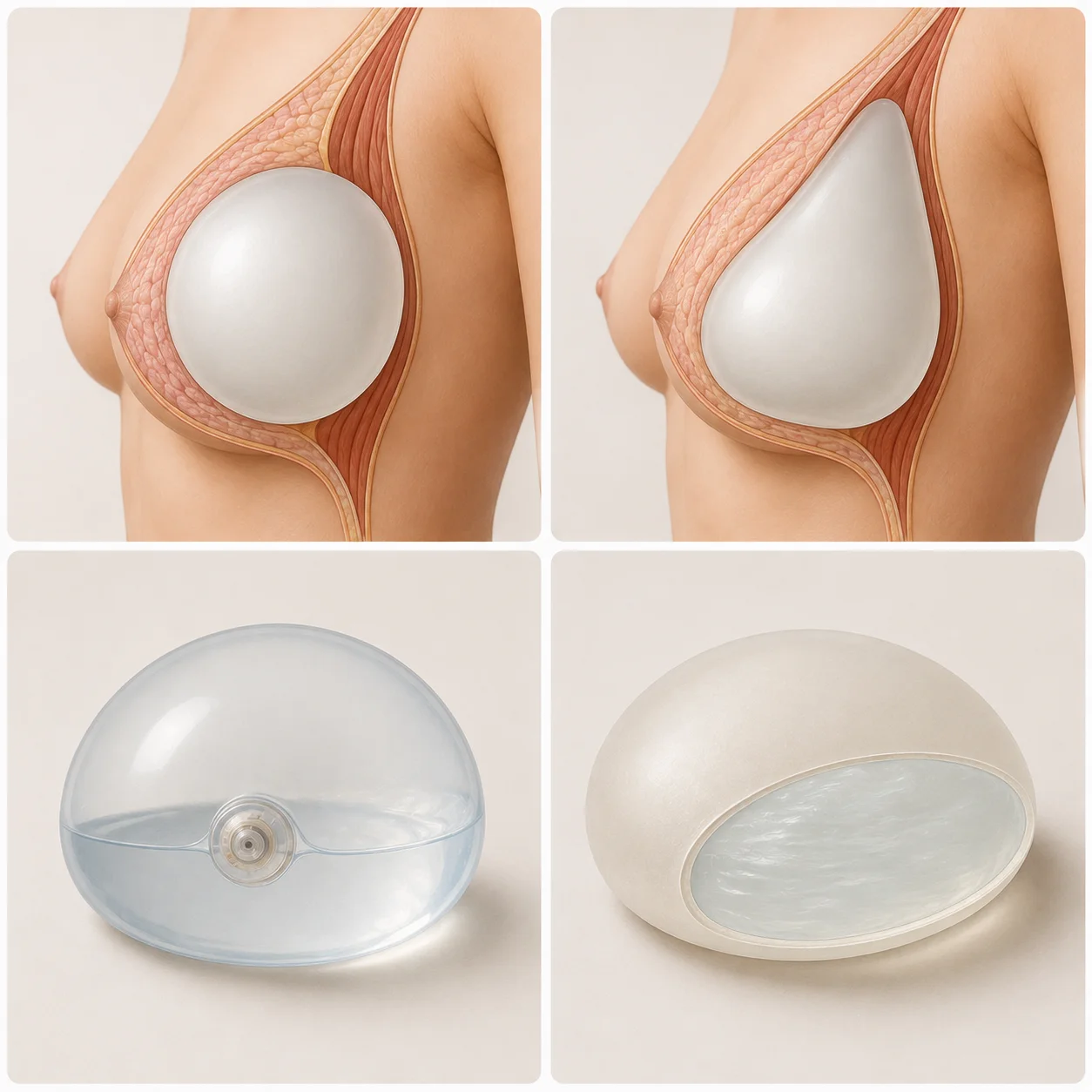
Breast augmentation requires several choices to be made beyond just electing to undergo the surgery. Decisions regarding the type of implant used, the shape of the implant, its size, and even the positioning of the implant relative to the pectoral muscles must be made, as all of them affect the outcome, the look, and the recovery process.
This article outlines the main decisions required from you in simple terms, giving you the chance to come to the consultation fully prepared and aware of what to consider and what questions to ask. Naturally, there is no single answer for all and proper physical examination is required to come up with the right decisions for you.
Contents
-
Implant Types: Saline vs Silicone
-
Implant Shapes: Round vs Anatomical
-
Implant Surface Texture: Smooth vs Textured
-
Understanding Implant Sizing
-
Placement Options: Where the Implant Sits
-
How Surgeons Help You Choose
-
Recovery Considerations Across Different Choices
-
Long-Term Considerations
-
Malaysian Patient Considerations
-
Conclusion & Frequently Asked Questions
Implant Types: Saline vs Silicone
There are two basic implant types that are used, the saline or silicone. This is the initial choice for the patient to make.
The saline implant is filled with sterile salt water. This filling is done during surgery or afterwards via the valve system. Being filled after being put into the breast, the saline implant allows making a smaller incision than in the case of silicone implant.
The silicone implant is already filled with the so called cohesive silicone gel. It tries to resemble as closely as possible the natural breast tissue. The size of the incision in this case should be bigger since this type of implant is not filled after its insertion.
The important facts to know:
-
The silicone implant is more realistic and natural, especially if you have less natural breast tissue
-
The saline implant allows making a smaller incision but some people claim they are a bit less realistic
-
If your saline implant raptures, this situation will be immediately visible as the saline will be absorbed by your organism
-
If your silicone implant raptures, you may not even notice it, therefore it is better to monitor this type of implant periodically
Implant Shapes: Round vs Anatomical
Implants are also classified into two types according to their shapes, namely round and anatomical (or teardrop-shaped).
Round implants have a symmetrical shape along all its dimensions; therefore, there is no problem with implant rotation affecting the outcome.
Anatomical implants, on the other hand, have a specific shape resembling that of a natural breast - fuller at the bottom and gradually tapering off toward the top.
Key differences:
-
Round implants usually give more fullness towards the upper portion of the breast.
-
Anatomical implants, on the other hand, try to achieve a gradual slope resembling that of a natural breast.
-
As anatomical implants are not symmetrical, there is a chance of rotation affecting the outcome, unlike round implants.
Implant Surface Texture: Smooth vs Textured
In addition, implants may be available as either smooth or textured in terms of their surface appearance.
Smooth implants allow for easier mobility of the implant in the surgical pocket and some surgeons believe this provides a more natural movement.
Texture implants were developed as a means of reducing implant rotation and increasing adherence of the tissue, but this is a concept that has evolved in recent times and this deserves special discussion with your surgeon
There are many things that have changed in plastic surgery over time and the surface texture of implants is one of those issues that should be discussed with your surgeon at the consultation stage.
Understanding Implant Sizing
Cup size is not the only factor that needs to be considered in terms of implants; implants are sized according to volume, measured in cubic centimetres (cc), while the cup size will depend upon the individual's current chest and breast dimensions.
|
Sizing will be affected by: |
|
Surgeons often employ various techniques for helping women visualise how they would look with different size implants through the use of sizing devices, trial fitting with various implant sizers, or 3D imaging in consultation.
Placement Options: Where the Implant Sits
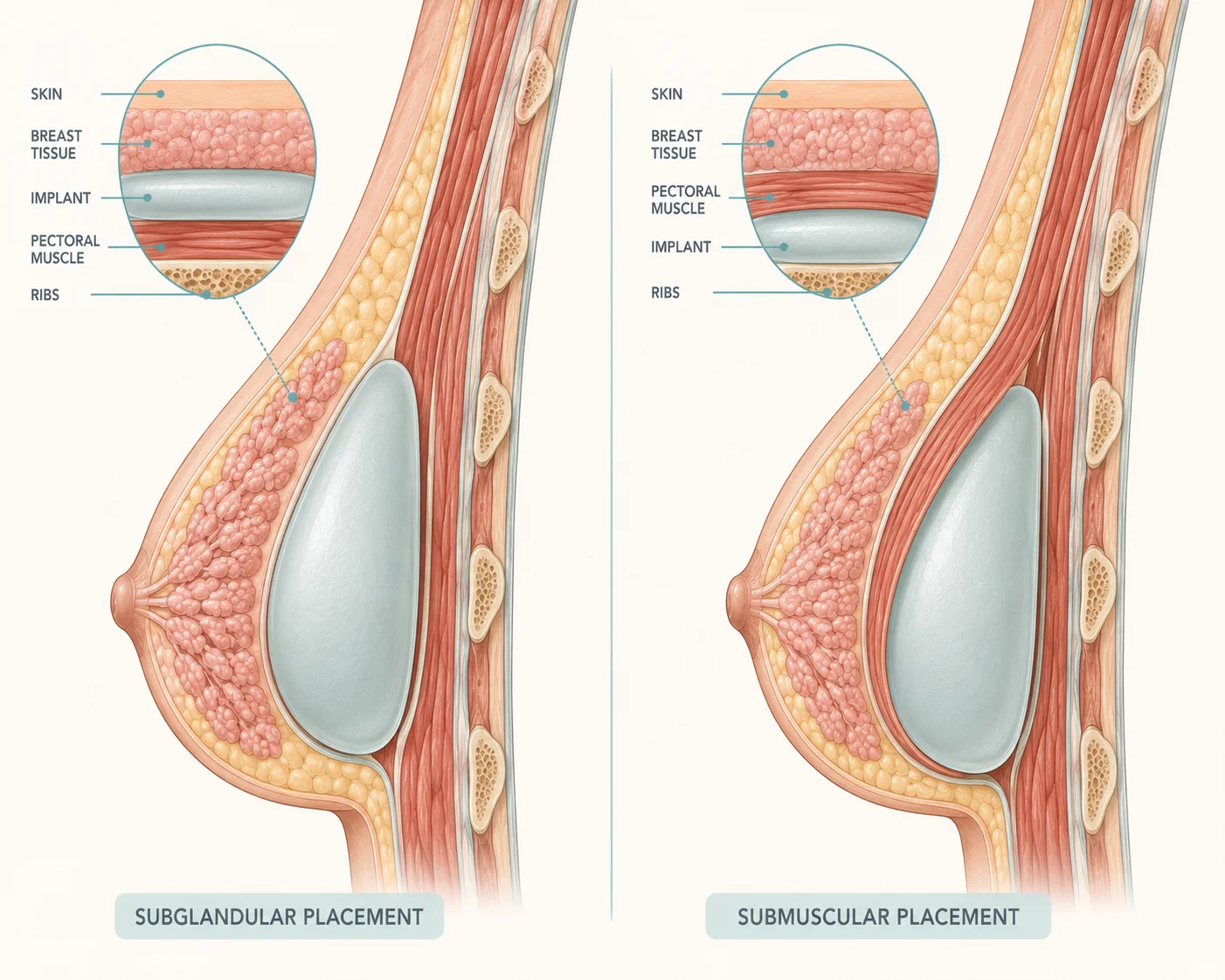
An implant may be placed at various points relative to the chest muscle. This placement will impact both aesthetics and recovery.
Placement of an implant subglandular means the implant is located above the chest muscle, directly under breast tissue.
Placement of an implant submuscular (also known as subpectoral) means that the implant is located either partially or completely under the chest muscle.
Important distinctions to keep in mind:
-
Placement submuscular is typically characterized by a more natural transition at the top of the breast especially in patients with less natural tissue coverage
-
Placement subglandular is usually characterized by a slightly shorter recovery in terms of muscle-related pain because there's no manipulation of the muscle
-
Placement submuscular is sometimes preferable for thin patients when the muscle provides extra coverage
-
Recovery submuscular may take some extra time due to the involvement of the muscle
Fill Material
|
Factor |
Saline |
Silicone |
|
Feel |
Can feel slightly firmer |
Generally feels more natural |
|
Incision size |
Smaller |
Somewhat larger |
|
Rupture detection |
Usually immediately noticeable |
Not always immediately obvious |
|
Monitoring needs |
Less ongoing monitoring required |
Periodic monitoring generally recommended |
Placement
|
Factor |
Subglandular |
Submuscular |
|
Location |
Above chest muscle |
Partially or fully beneath chest muscle |
|
Natural transition |
Can be less gradual in thinner patients |
Often more gradual and natural-looking |
|
Initial recovery |
Generally less muscle-related discomfort |
Can involve more discomfort initially |
|
Best suited for |
Patients with more natural tissue coverage |
Thinner patients needing more coverage |
How Surgeons Help You Choose
In your consultation, your surgeon will likely evaluate the following factors:
-
The condition of your breast tissue, skin, and chest wall
-
The end result you wish to achieve, which includes the size and shape that you want to aim for
-
Your current lifestyle, which may include any activities where the feel and movement of the implants may be an issue
-
Any history in your medical background that could affect the materials or placements of the implants
This custom evaluation is the reason why two patients with the same aesthetic goal will end up with completely different combinations of implants.
Recovery Considerations Across Different Choices
Although there are similarities in terms of breast augmentation recovery time depending on what decision a patient makes, the following things could be different depending on the decision:
-
The submuscular technique is often associated with higher levels of pain due to the chest muscle being used during the procedure.
-
The choice of larger implants may result in the recovery taking longer since the tissue needs to stretch in order to accommodate a bigger volume.
-
The size of the incision, which is usually smaller in case of saline implants, does not play an important role in the recovery time of most patients.
No matter what the patient opts for, it will take about a week or two for them to return to normal routine.
Long-Term Considerations
Breast implants are not always designed to be lifelong devices, and patients should be prepared to undergo further surgery to either replace or remove their implants at some stage in the future because of changing preferences or changes within the implants themselves. The necessity for regular appointments with your surgeon and any special surveillance required for silicone implants is a key part of breast implant maintenance.
Cost Factors to Understand
The price of breast augmentation depends on what kind of implants are used, the size of the implants, how the surgery will be performed, and which medical facilities will be performing the procedure. It should be noted that silicone implants cost slightly more compared to saline implants.
Conclusion
Decisions such as those related to the type of implant, its size, and the way that it is placed in the body play an integral part in achieving successful breast augmentation. Having some knowledge about such aspects allows you to make a more knowledgeable and constructive discussion during your consultation when your unique anatomical needs and personal preferences will become obvious.
Frequently Asked Questions
Which feels more natural, saline or silicone?
However, silicone implants are supposed to be more natural, especially in women that have very little natural breast tissues, although personal experience may differ.
Do I need regular check-ups after getting silicone implants?
It should also be noted that periodic follow-ups should be conducted for silicone implants, since sometimes their rupture cannot be noticed as quickly as that of saline implants. Your surgeon will give you recommendations about the right timing.
Can I choose exactly what cup size I want?
Implant sizes are measured in volume, not in cups, and the cup size will depend on your individual features. It is possible to translate your aesthetic expectations into the corresponding implant size.
Is submuscular placement more painful than subglandular?
In case of submuscular implantation, there will be slightly more initial discomfort because your chest muscle will take part in the healing process.
Will my implants need to be replaced eventually?
Implants are not usually intended to be lifetime devices, and most people will eventually get their implants replaced or even removed because of personal choice or problems with the implants. You should consider this as you plan for the future.
What's the difference between round and anatomical implants in terms of how they look?
However, round implants will give fuller results at the top of the breast whereas anatomical implants will create a smoother slope. The best choice will depend on your individual preference.