
If you have started looking into facelifts you have probably come across a lot of words like deep plane and SMAS and mini facelift. These words are often used in the way in advertisements but they actually refer to different kinds of surgery. Each type of surgery has results takes different amounts of time to recover from and is more or less invasive.
This can make it even harder to decide what to do. This guide will explain what each type of facelift really is, how they are different, from each other and what kind of person each type of facelift is suited for. This way when you go to talk to a doctor you will know what questions to ask about facelifts and what to expect from a facelift.
Contents
-
Why Facelift Techniques Differ So Much
-
Understanding the Facial Layers Involved
-
What Is a SMAS Facelift
-
What Is a Deep Plane Facelift
-
What Is a Mini Facelift
-
Who Tends to Suit Each Technique
-
Recovery Differences Between the Three
-
Results and How Long They Tend to Last
-
Scarring Considerations
-
Conclusion & Frequently Asked Questions
Why Facelift Techniques Differ So Much
Facelift surgery isn't a single, standardised procedure - it's a category of techniques, each addressing the ageing face at a different depth and with a different level of surgical complexity. The main difference between them comes down to which facial layer is lifted and repositioned, and how much of the face is addressed.
Understanding this is the key to understanding why these three techniques produce different results, require different recovery times, and suit different patients.
Understanding the Facial Layers Involved
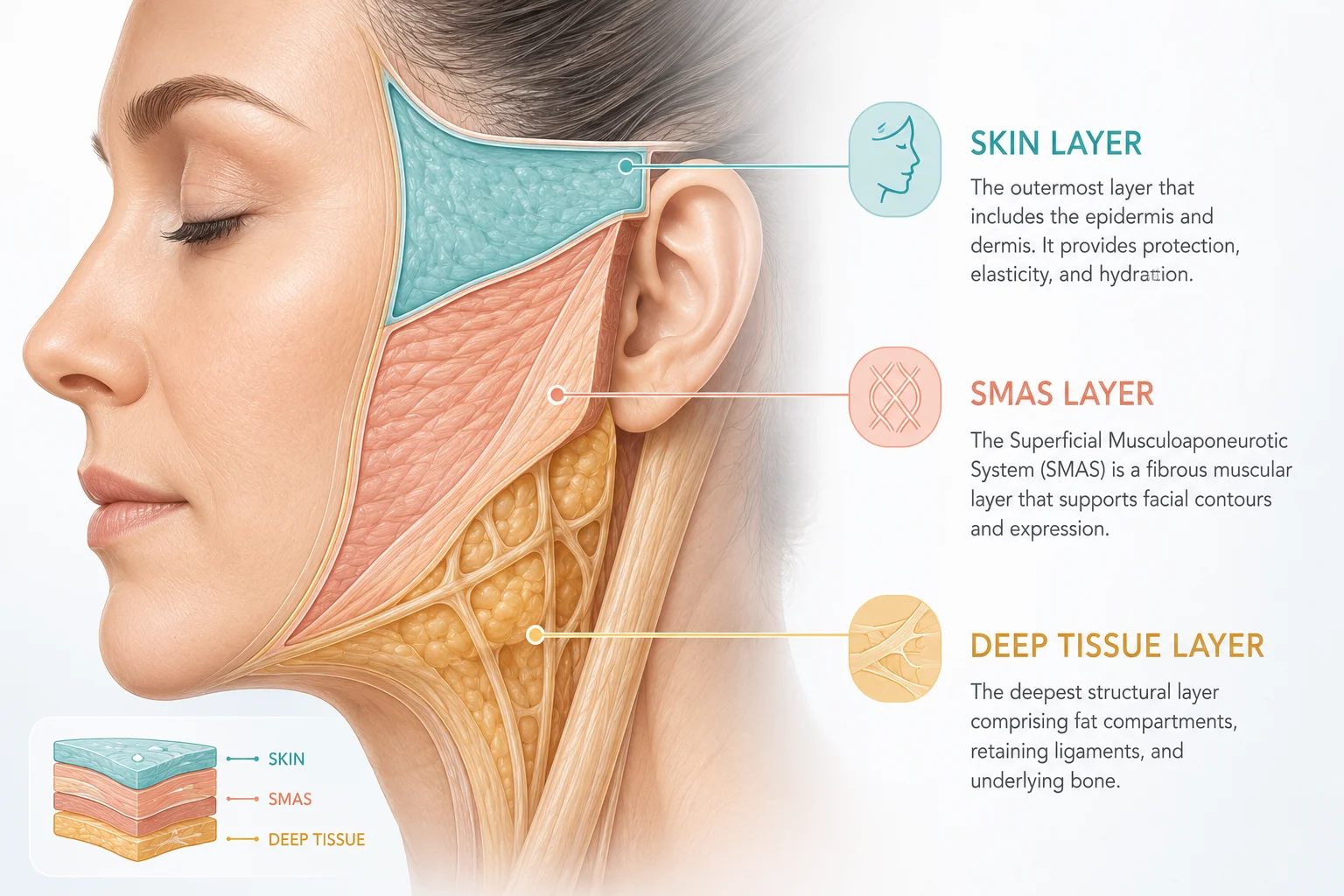
To get the difference between these techniques you need to know that the facial tissue is made up of layers. The skin, a layer with fibers and muscles called the SMAS and then there are deeper structures below that.
-
A mini facelift usually works on an area that mostly focuses on the skin and tissue in the lower part of the face.
-
A SMAS facelift lifts and moves the muscular layer, not just the skin so it gives more support to the results.
-
A deep plane facelift goes further; it releases and moves the tissue that is beneath the SMAS layer so the surgeon can move the deeper structures of the face as one unit.
The fact that each technique works on layers is really the main thing that sets them apart, from each other.
What Is a SMAS Facelift
A SMAS facelift is a popular way to lift your face. It works by lifting and moving the SMAS layer under your skin. This is different from pulling your skin tight.
Key points about a SMAS facelift:
-
A SMAS facelift fixes both your skin and the muscles under it. This means you get results that look more natural and last longer than if you just got a skin lift.
-
A SMAS facelift is good for a lot of people who have signs of aging on their face and neck.
-
You will need some time to recover after a SMAS facelift. It takes longer to recover than a facelift but not as long as some other types of facelifts.
-
The SMAS facelift has been around for a time and is one of the most well-known and studied ways to lift your face.
What Is a Deep Plane Facelift
A deep plane facelift is a more advanced, comprehensive technique that goes beneath the SMAS layer, releasing deeper facial ligaments and repositioning tissue as a more unified structure, rather than only lifting the more superficial muscular layer.
Key points about a deep plane facelift:
-
Addresses deeper facial structures, which can allow for more comprehensive repositioning of sagging tissue, particularly in the mid-face and jawline
-
Often associated with more natural-looking movement in the repositioned tissue, since deeper structures are moved together rather than just pulled at the surface
-
Generally a more technically demanding procedure, requiring significant surgical experience and precision
-
Typically involves a longer recovery period compared to SMAS or mini facelift techniques, given the more extensive nature of the surgery
What Is a Mini Facelift
A mini facelift, sometimes called a "weekend facelift" in marketing contexts, is a more limited procedure, generally addressing a smaller area of the face - often the lower face and jowls - with smaller incisions and a less extensive surgical approach.
Key points about a mini facelift:
-
Addresses early to moderate signs of ageing, generally in a more limited facial area
-
Involves smaller incisions and typically a shorter procedure time compared to SMAS or deep plane techniques
-
Generally offers a shorter recovery period, which is part of why it's sometimes marketed toward patients wanting less downtime
-
Results are typically less extensive and may not last as long as SMAS or deep plane techniques, given the more limited scope of tissue repositioning
|
Factor |
Mini Facelift |
SMAS Facelift |
Deep Plane Facelift |
|
Layer addressed |
Primarily skin, limited area |
Skin and SMAS muscular layer |
SMAS and deeper structures beneath it |
|
Extent of correction |
Limited, often lower face only |
Moderate, broader facial area |
More comprehensive, including mid-face |
|
Best suited for |
Early signs of ageing |
Moderate ageing signs |
More advanced ageing signs |
|
Surgical complexity |
Lower |
Moderate |
Higher, more technically demanding |
|
Typical recovery |
Shorter |
Moderate |
Longer |
|
Longevity of results |
Generally shorter-lasting |
Generally longer-lasting than mini |
Often considered longer-lasting |
Who Tends to Suit Each Technique
Mini facelift tends to suit:
-
Patients with earlier, milder signs of facial ageing
-
Those wanting a shorter recovery period
-
Patients whose main concern is limited to the lower face or jowls
SMAS facelift tends to suit:
-
Patients with moderate signs of facial and neck ageing
-
Those wanting a well-established, broadly effective technique
-
Patients comfortable with a moderate recovery period in exchange for more comprehensive, longer-lasting results
Deep plane facelift tends to suit:
-
Patients with more advanced signs of ageing, particularly in the mid-face
-
Those seeking a more comprehensive repositioning of deeper facial structures
-
Patients prepared for a longer recovery period in exchange for potentially more natural, longer-lasting results
Recovery Differences Between the Three
The time it takes to get better from a facelift is usually related to how much work's done. If you have a facelift you will probably be back to your normal routine pretty quickly. This is because the mini facelift is not as involved as types of facelifts.
A SMAS facelift takes a bit longer to recover from. You will likely have some swelling and bruising that will take a week to go away.
A deep plane facelift is a serious type of facelift. It takes the time to recover because it involves working on deeper tissue.
No matter what kind of facelift you have you will probably have some swelling and bruising. This is a normal part of the process. It can take months for the swelling to completely go away and for you to see the final results of your facelift.
Scarring Considerations
When people get a facelift the doctor makes cuts around the hairline and ear. This is so you can not see the cuts after they have healed. A mini facelift is a procedure so the cuts are smaller too.
The SMAS and deep plane facelifts are procedures so the doctor has to make bigger cuts.. The doctor tries to make these cuts in a way that they are not easy to see after they have healed. The doctor wants the facelift cuts to be hard to see so they put them around the hairline and ear. This way the facelift is not very noticeable once it has healed.
Malaysian Patient Considerations
In Malaysia the warm and humid weather can sometimes make swelling more obvious during the stages of recovery. It is an idea to stay in cooler places with air conditioning and to follow the instructions given by your surgeon to help deal with this during the warmer weeks of recovery.
When it comes to work and social activities the recovery time varies depending on the technique used. It is an idea to talk about your work schedule and any social events you have planned during your consultation. This way you can pick a technique and a time that fits well with your life. This is especially important if you are worried about bruising or swelling affecting your ability to go to events or go back to work.
Sun protection is very important during the healing process. In Malaysia the sun is strong and always shining. It is essential to protect your skin carefully during the recovery, from a facelift. UV rays can affect how your scars heal and how your skin looks during this time when your skin's very sensitive.
Conclusion
Deep plane, SMAS and mini facelift procedures all deal with signs of aging on the face in their way. They work at levels and focus on different parts of the face. Deciding which one is best for you depends on how old you are, what you want to achieve, how much time you can take to recover and what a trained doctor says is right for your body during a real meeting.
Of picking a procedure just because of the words used to describe it learning what each one really means. As explained in this guide. Helps you have a much better talk during your meeting with the doctor.
Frequently Asked Questions
Which facelift technique lasts the longest?
The deep plane facelift is a comprehensive technique that gives longer-lasting results because it deals with the deeper causes of aging.. The results are different for each person and depend on the quality of their skin, their genetics and the way they live their life.
Is a deep plane facelift more painful than a SMAS facelift? Recovery
People heal at rates but the deep plane facelift usually takes longer to recover from because it is a bigger procedure. This means there will be more swelling and bruising at first compared to procedures.
Can I combine a mini facelift with other procedures?
In some cases it is possible to have more than one procedure at the same time depending on what you want to achieve and what your surgeon thinks is safe. Your surgeon will talk to you about this when you first meet with them.
How do I know which technique is right for my face?
You need to meet with a surgeon in person so they can look at your skin, the shape of your face and how much you have aged. This is the way to know which technique is right for you. This guide is just to help you understand what is available, it is not a substitute for an assessment.
Is a mini facelift a good alternative if I want less downtime?
A mini facelift is something to think about for people who are just beginning to see signs of aging. It is only affecting a small part of their face. The mini facelift will not last for a time or be as effective as a deep plane facelift so you need to be realistic about what a mini facelift can do and what it cannot do.