
Walk into any aesthetic clinic today and you will hear both words: exosomes and secretome. Some clinics use them interchangeably others treat them as different products and patients are left guessing which one is which. The confusion is understandable because the two terms overlap. This guide explains how they relate, how they differ and what to ask before you book either.
What Are Exosomes ?
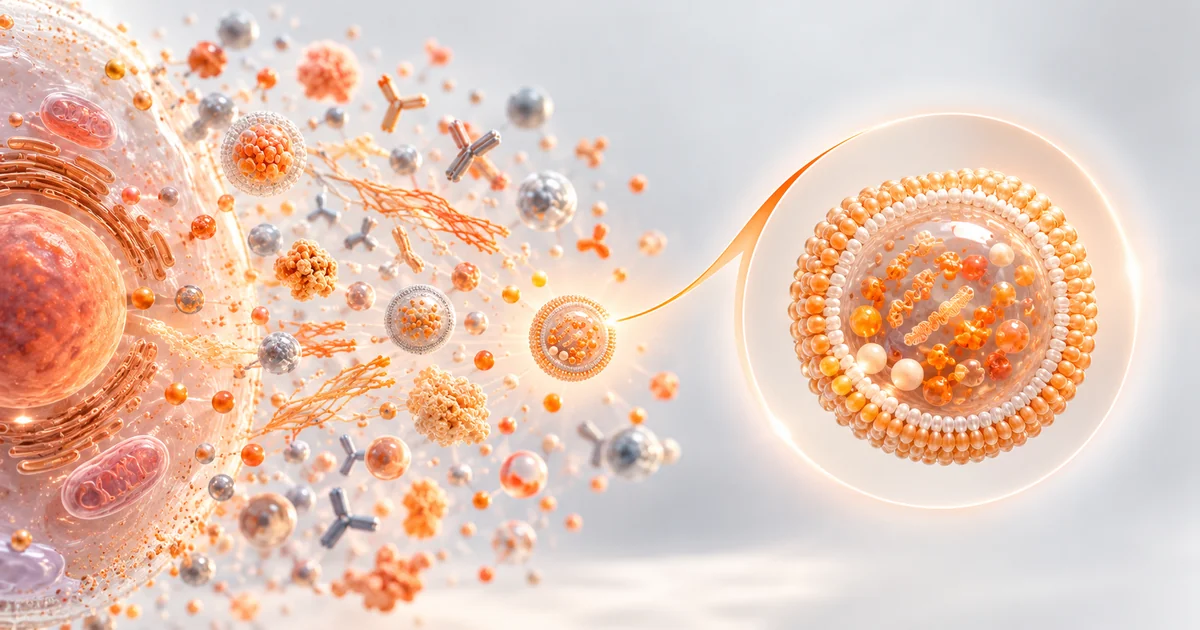
Exosomes are one component of the secretome. The secretome is everything a cell releases into its surroundings, while exosomes are a specific type of tiny vesicle within that mixture. A useful way to picture it: the secretome is the full set of messages a cell sends, and exosomes are one kind of envelope those messages can travel in.

|
Factor |
Secretome |
Exosomes |
|
Definition |
All molecules secreted by cells |
A specific subset of extracellular vesicles |
|
Contents |
Soluble proteins, growth factors, cytokines, lipids plus vesicles |
Proteins, lipids and RNA enclosed in a membrane |
|
Living cells? |
No |
No |
|
Relationship |
The whole |
One part of the whole |
What Is the Secretome?
The secretome is the complete collection of molecules that cells release into the space around them. In aesthetic and regenerative medicine, it usually refers to the output of cultured cells, often mesenchymal stem cells from umbilical cord, adipose tissue or bone marrow.
A secretome contains two broad groups of material:
-
Soluble factors: growth factors, cytokines, chemokines, enzymes and extracellular matrix proteins that move freely in the fluid
-
Extracellular vesicles: membrane-bound particles, including exosomes, that carry proteins, lipids and RNA
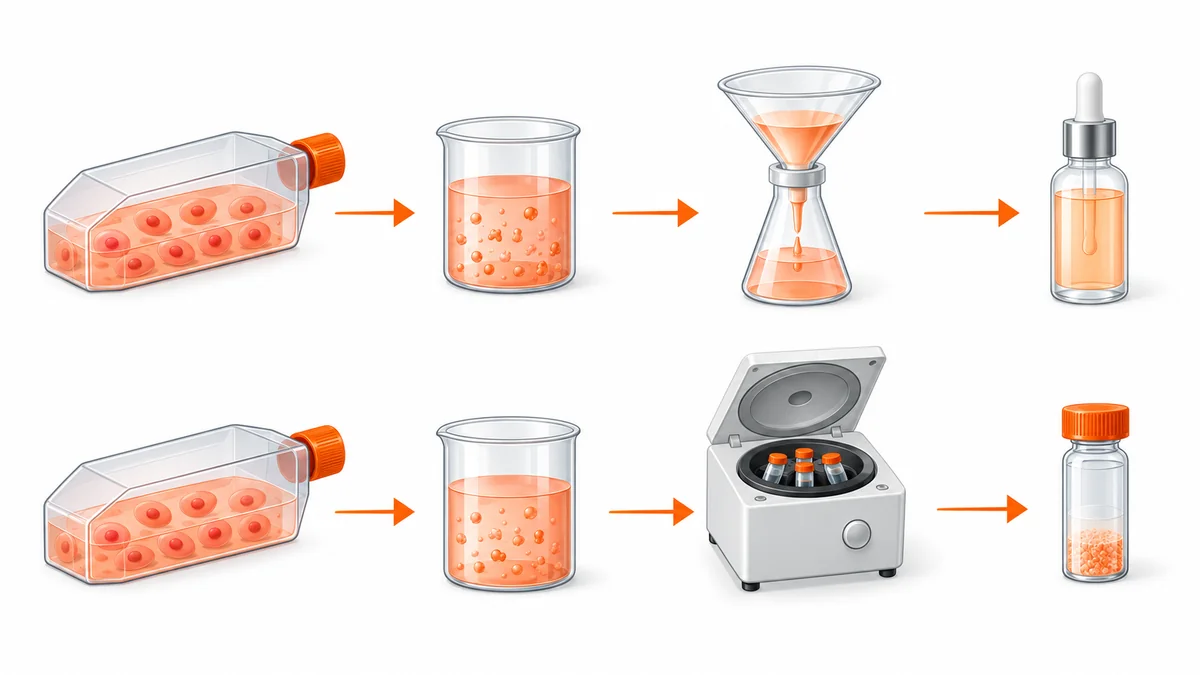
Secretome products are typically made from conditioned medium, which is the liquid in which cells have been grown. It is collected, clarified, filtered, and sometimes concentrated or freeze-dried. No living cells remain in the final product.
What Are Exosomes?
Exosomes are a type of vesicle usually 30 to 150 nanometres across. Exosomes are made inside a cell through the pathway. Small vesicles bud inward inside structures called multivesicular bodies. These multivesicular bodies then fuse with the cell membrane and release Exosomes. Exosomes carry cargo such as proteins, lipids and microRNA. Cargo can change how nearby cells behave. I find it fascinating that Exosomes can influence cells.
Researchers commonly identify them using marker proteins such as CD9, CD63, CD81 and TSG101. Exosomes are not the only vesicles cells release. Microvesicles bud directly from the cell surface and are generally larger, and apoptotic bodies are larger still.
How the Two Are Made
|
Step |
Secretome Products |
Exosome Products |
|
Starting point |
Cultured cells in growth medium |
Cultured cells in growth medium |
|
Collection |
Conditioned medium is collected |
Conditioned medium is collected |
|
Processing |
Clarified, filtered, sometimes concentrated or lyophilised |
Vesicles are isolated and concentrated |
|
Typical methods |
Centrifugation, filtration |
Ultracentrifugation, size-exclusion chromatography, tangential flow filtration |
|
Result |
Whole mixture of soluble factors and vesicles |
Vesicle-enriched preparation |
This is where the line blurs in practice. Many products sold as "exosomes" are in fact mixed vesicle populations that may also contain soluble proteins. The International Society for Extracellular Vesicles recommends using the broader term "extracellular vesicles" unless a preparation can be shown to be of endosomal origin. A product labelled "exosome" is therefore not automatically purer or more precisely defined than a secretome.
Why the Difference May Matter
Potential advantages of exosome-focused products
-
A more defined particle fraction that can be characterised by size and markers
-
A clearer target for researchers studying delivery and mechanism
Potential advantages of secretome products
-
They retain soluble growth factors and cytokines that may contribute to the biological effect alongside vesicles
-
Processing can be simpler than isolating purified vesicles
Shared limitations
-
Composition varies between manufacturers, cell sources and batches
-
There is no universal standard for potency or dose
-
Neither has been shown to be consistently superior to the other in head-to-head human trials
What Does the Evidence Say?
Both are active areas of research, and both remain early-stage. Laboratory and animal studies show that MSC-derived vesicles and secretome can influence inflammation, fibroblast activity and wound healing. Small human studies, mainly in skin rejuvenation, post-laser recovery and hair thinning, have reported encouraging but modest findings.
The limits are significant:
-
Most studies are small, short and use different products and protocols
-
Few are large, blinded, placebo-controlled trials
-
Long-term outcomes are largely unknown
-
Evidence for one product type cannot be assumed to apply to another
Where Each Is Used in Aesthetic Practice
In clinics, both are most often used as adjuncts rather than standalone treatments:
-
Applied to skin after microneedling or fractional laser to support recovery
-
Used as a topical skin booster for texture and hydration
-
Applied to the scalp alongside established hair loss treatments
Regulation and Safety
Neither exosome nor secretome products are approved by major regulators, including the US FDA, as treatments for disease. The FDA has issued a public safety notification warning that exosome products marketed to treat diseases are unapproved, and has noted serious adverse events linked to some unregulated products. In Malaysia, how a product is regulated depends on its composition and the claims made for it, so asking for documentation is reasonable.
Reported risks include:
-
Skin irritation or allergic reaction
-
Infection from contaminated or poorly handled products
-
Inflammatory reactions, particularly with injected unregulated products
-
Variable quality between suppliers
Red Flags in Marketing
|
Claim |
Why It Deserves Caution |
|
"Cures" or "reverses" a disease |
No such approval or proof exists |
|
"Contains stem cells" for an exosome or secretome product |
These products are cell-free |
|
"Purest exosomes" with no data |
No universal purity standard is applied across clinics |
|
Intravenous or injected use for general anti-ageing |
Higher risk and little supporting evidence |
|
Cannot name the cell source or manufacturer |
Source and testing are fundamental to safety |
Questions to Ask Before Treatment
-
What cells is this product made from, and where is it manufactured?
-
Is it an exosome-enriched product or a whole secretome, and how is that confirmed?
-
Is it tested for sterility and endotoxin, and can I see the report?
-
What is its registration status under Malaysian rules?
-
What evidence supports its use for my concern, and what are the realistic limits?
Frequently Asked Questions
Are exosomes and secretomes the same thing?
No they are not the same. Exosomes are a part of the secretome. The secretome includes all the molecules that cells release such as factors and different types of vesicles.
Which one is better for skin rejuvenation?
There is no winner. Both have shown modest results in small studies but there are no direct human trials that prove one is consistently better than the other.
Do either of them contain stem cells?
No. Both are cell- products. They come from what cultured cells release. Any product that claims to be exosomes or secretome but contains living stem cells is not what it says it is.
Are exosome or secretome treatments approved?
Not yet. No major regulatory body, including the US FDA has approved them for treating diseases. If you're considering treatment, ask your clinic about where the product comes from, how it’s tested and whether it's registered under regulations.
Can they be used with microneedling or PRP?
Often yes, as added treatments. Your doctor will decide what’s best for your skin and your goals. Combining treatments doesn’t always mean results.
The Bottom Line
Exosomes sit inside the secretome. The real question is not which word sounds more advanced but which product is well made, well documented and honestly described. Both products are promising, early‑stage options, best used as treatments under proper medical guidance. To discuss which exosome approach if any suits your skin, book a consultation with our team.