
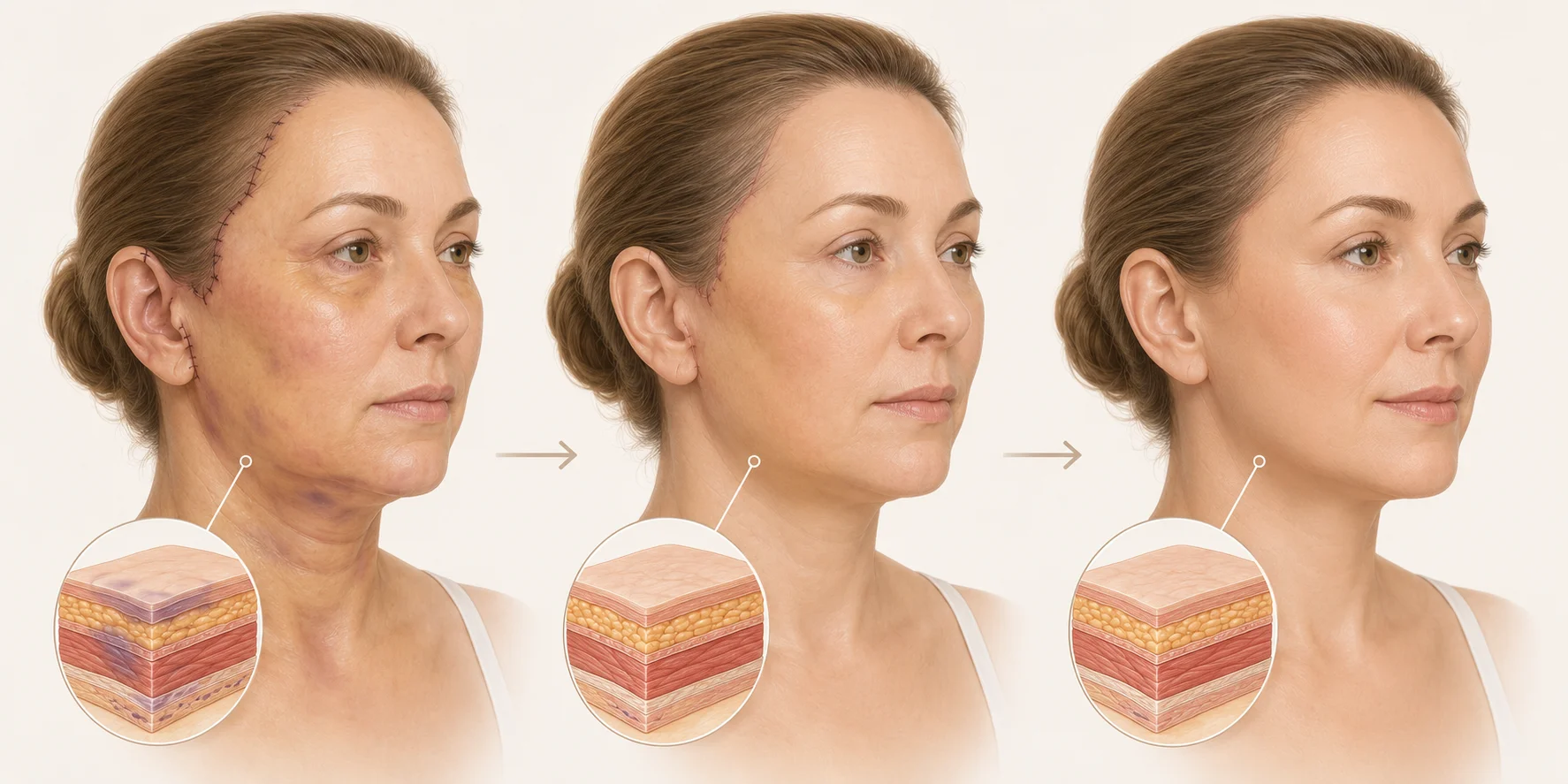
People who are going to have facelift surgery usually want to know what happens after the surgery. They want to know how swollen their face will be. They want to know when they can go out in public again. They want to know when they will look like themselves again.
This guide will tell you what to expect during the recovery from facelift surgery. It will tell you what happens each day at first. Then each week after that. This way you can get an idea of what your recovery will be like. The recovery time can be a little different depending on the type of facelift surgery you have. Like a plane facelift, a SMAS facelift or a mini facelift. So this guide is general and not specific to your surgery.
Contents
-
Day 1: Right After Surgery
-
Days 2-3: Peak Swelling and Bruising
-
Days 4-7: Gradual Improvement Begins
-
Week 2: Returning to Light Activity
-
Weeks 3-4: Looking More Like Yourself
-
Weeks 5-8: Settling Into Final Shape
-
Months 2-3: Residual Swelling Resolves
-
Months 4-12: Final Results Mature
-
Signs That Need Prompt Medical Attention
-
Factors That Can Affect Your Personal Timeline
-
Conclusion & Frequently Asked Questions
Day 1: Right After Surgery
The day after the procedure is usually a day of rest. You will probably feel a bit tired and sleepy because the anaesthesia is still wearing off.
What you can expect on the day:
-
There will be bandages or a special tight garment around your face and maybe your neck. This depends on what kind of procedure you had.
-
Your face and neck will start to swell and bruise. This might be worse than you thought it would be on the day.
-
You should try to keep your head up high even when you are sleeping or resting. This helps to reduce the swelling.
-
You might feel a bit uncomfortable but it is usually not too bad. The doctor will give you some medicine to help with the pain.
-
It is an idea to have someone with you for the first night. You will not be able to drive a car. You might still feel dizzy, from the anaesthesia.
Most people feel very tired on the day and they just want to rest quietly. They do not want to do anything. The procedure is still fresh so your face and body need time to recover. Resting quietly on the day is what most patients do and it is what you should do too instead of trying to do things.
Days 2-3: Peak Swelling and Bruising
This is typically when swelling and bruising are at their most pronounced - often more dramatic-looking than patients anticipate, which can feel alarming even though it's a completely normal part of healing.
What's typical during days 2-3:
-
Swelling often peaks around this stage, sometimes appearing worse before it starts to improve
-
Bruising may spread slightly beyond the immediate surgical area, including potentially down the neck or under the eyes, depending on the extent of surgery
-
Drains, if placed, are often monitored and may be removed around this time, depending on drainage output
-
Rest remains the priority, with continued head elevation to support swelling reduction
-
Any initial dressings may be changed or adjusted during a follow-up visit around this stage
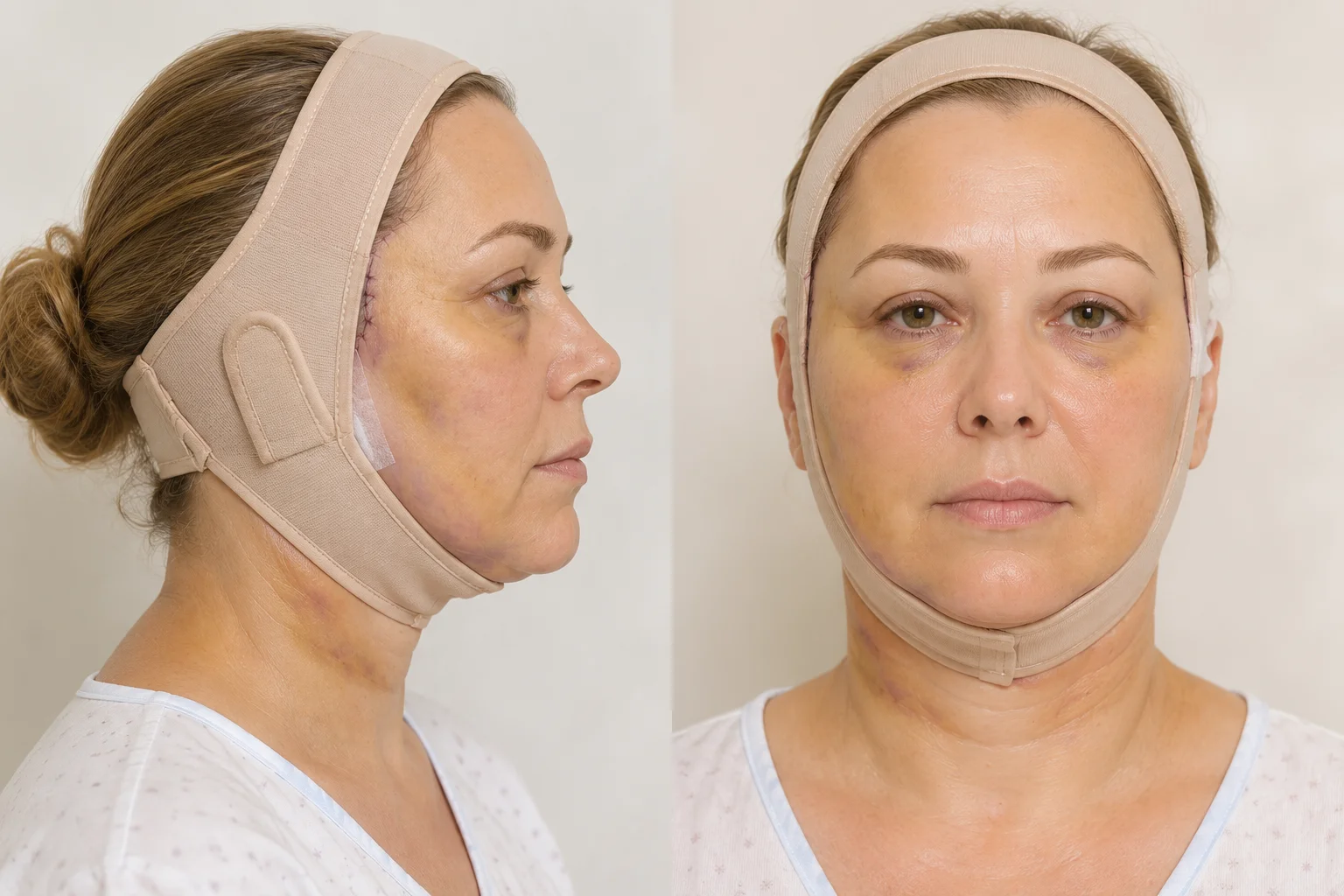
It's common for patients to feel discouraged at this point, seeing the most swollen version of their face - this is genuinely the most dramatic-looking stage, and it does improve from here.
Days 4-7: Gradual Improvement Begins
By the end of the week most patients see the swelling and bruising starting to get better. The swelling and bruising are still there. They are not as bad as they were.
Here is what usually happens during days 4-7:
-
The bruising starts to change color as it heals. It can turn purple then. Then yellow before it goes away.
-
The swelling starts to go down. It is still easy to see during this time.
-
If the doctor used stitches or staples they might take them out around the end of the week. This depends on what the surgeon thinks is best.
-
People can usually do things around the house without too much trouble.
-
Most patients do not want to go out in public because they still have bruises and swelling.
A lot of patients take at least a full week off from work and social things to get through this part of the recovery. This is because the bruising and swelling are still very visible, during this time. Patients plan for this so they can stay home and rest while their body heals from the surgery and the swelling and bruising get better.
Week 2: Returning to Light Activity
By the week many patients feel that things are getting better even though their body is still healing on the inside.
What usually happens during week 2:
-
Bruising starts to go and it is not as bad as it was before. Some people may still have a bit of color change but they can cover it up with makeup if their surgeon says it is okay.
-
The swelling gets better. Some parts of the face like the jawline or under the chin may still be a bit puffy.
-
Many patients go back to work at this point especially if they do not have to meet a lot of people or if they can work from home. They usually wait until the bruising is not too bad.
-
Patients can usually start doing some exercise like taking short walks.. They have to wait a bit longer to do anything more serious.
-
The surgeon will usually see the patient again around this time to see how they are healing and to tell them what to do.
Weeks 3-4: Looking More Like Yourself
This period really feels like a big change is happening, with most of the signs of surgery going away.
Here is what usually happens during weeks 3-4:
-
Bruising is much gone for most people by this time
-
Swelling is still going down. You can still see a little bit of puffiness and this is something that the patient is more likely to notice than other people
-
Most people are okay with being, in public and they can use makeup to cover up any color that is not right
-
You can usually start exercising like normal around this time but you have to listen to what your surgeon says and think about what kind of surgery you had
A lot of people say that this is when they start to feel like themselves again even though it is going to take some more time for the final result to be just right. Surgery is still something that they are getting used to and the final result of the surgery is still being refined. People are still thinking about their surgery. How it is affecting them and they are waiting for the final result of the surgery to be complete.
Weeks 5-8: Settling Into Final Shape
By this stage, most patients look outwardly healed, even though some final, subtle changes are still occurring beneath the surface.
What's typical during weeks 5-8:
-
Residual swelling continues to resolve gradually, often most noticeable by the end of a long day or after salty food
-
Numbness or altered sensation, if present after surgery, generally continues to improve gradually during this period
-
Scarring, if applicable to your specific technique, continues to soften and fade
-
Full return to exercise and normal routine is often permitted around this stage, subject to your surgeon's confirmation
Months 2-3: Residual Swelling Resolves
This time is mostly about the stages of swelling going away and your tissue getting back, to normal.
What you can expect during months 2 to 3:
-
Most of the swelling that you can see is gone so you can see your results clearly
-
Any numbness or tightness that is still there usually gets better. It can take a while for some people to feel things normally again
-
Your scars keep getting lighter and less noticeable; they just take time to heal and settle down so they are not as easy to see.
Months 4-12: Final Results Mature
Facial surgery healing is a process that keeps going on for a long time. It takes a lot longer than people think it will. You will not see the results until about a year after the surgery.
Here is what usually happens after four months:
-
The shape of your face becomes more defined as the rest of the swelling goes
-
Scars keep getting lighter and look their best around twelve months after the surgery
-
If you had any numbness the feeling in your face will probably come back. This is different for everyone
People heal at different rates. This is a general idea of what to expect. It is not a promise that your recovery will happen like this. Facial surgery healing is different for everyone. Facial surgery results take time to show up. They are different, for each person who has facial surgery.
Signs That Need Prompt Medical Attention
When you are recovering from a facelift you will probably have some swelling, bruising and discomfort. These things are pretty normal.. There are some signs that you should watch out for. If you notice these signs you should get in touch with your surgeon.
|
If something does not feel right and it is not what your doctor told you to expect you should call your surgeon. They can help you figure out what is going on with your facelift recovery. It is always better to be safe than sorry so do not wait to contact your team if you have any concerns about your facelift recovery.
Factors That Can Affect Your Personal Timeline
-
The type of facelift technique that was used is important. Facelift techniques that are more extensive usually take longer to recover from than facelift techniques that're not as extensive.
-
The facelift. Whether other procedures like eyelid surgery or neck lift were done at the same time as the facelift technique are important to consider.
-
The way the facelift technique heals is different for each person.
-
The person's age and how healthy they are can affect how quickly they heal from the facelift technique.
-
It also matters how well the person follows the instructions they get after the facelift technique, like what they can and cannot do and how to take care of their wounds after the facelift technique.
Most patients feel okay about going to their normal social life around three to four weeks after they have surgery. They might wear makeup to hide any marks that are still there. This is because it takes weeks for the marks to go away. It is different for each person. It also depends on how big the surgery was.
Conclusion
A facelift recovery usually follows a pattern that people can expect. There is a lot of swelling and bruising in the first few days then things get better slowly over the next few weeks and the final results take several months to settle. Knowing what to expect on a day by day basis can make the whole experience feel less confusing even though each person heals at their own pace.
If you are thinking about getting a facelift and want a recovery plan that's just right for the method used and your health, the best thing to do is to have a proper meeting with a surgeon. During that meeting the surgeon can explain what you can really expect for your situation.
Frequently Asked Questions
When will the swelling go down enough to go out in public?
Some people feel weird sensations around the area where they had surgery. This is normal. It gets better over time. It can take weeks or months for the numbness to go away completely. For some people it takes longer to feel normal again.
How long does numbness after a facelift typically last?
You can wash your hair after surgery. You just have to wait until your surgeon says it is okay. This is usually after one week. It also depends on how your surgeon did the surgery and where they made the cuts.
When can I wash my hair after a facelift?
It takes a month for the area to heal and look normal again.. It can take up to a year for everything to be completely back to normal. This is because your body is still healing and the scars are still changing.
When will I see my final results?
You can go back to your life after surgery.. You have to wait until your surgeon says it is okay. This is usually a week after surgery. It is different for each person. It depends on how fast they heal. Your surgeon will tell you when it is safe to go to your normal life.
Can I wear makeup during recovery to hide bruising?
Yes you can usually go back to work when your doctor says it is okay. This is often a week after your surgery. Your surgeon will tell you when your cuts are healed enough. It takes a week for most people to heal.
How long should I take off work after a facelift?
The time you need to take off work depends on the type of surgery you had and the kind of job you do. If you see a lot of people at work you might need to take time off. Many people take at least two weeks off work. Some people need to take off work especially if they still have a lot of bruising and swelling.