
Mini Facelift vs Full Facelift: What's the Difference?
Many patients come in asking the same question: do I need a mini facelift or a full facelift? The confusion is understandable. Both procedures address facial aging, but they work on very different levels and suit different people.
The right choice depends on how much sagging you have, where it is, your age, your skin quality, and how much downtime you can manage. This guide breaks down the differences clearly so you can go into your consultation feeling informed.
What Is a Mini Facelift?
A mini facelift is a shorter, less invasive version of a traditional facelift. It uses smaller incisions, typically placed around the ears and hairline, to lift and tighten the lower face.
The procedure targets early signs of aging: jowl formation, mild skin laxity around the cheeks, and the beginning of neck looseness. It does not address deep facial structures or significant volume loss.
Because the incisions are smaller and tissue work is more limited, recovery is faster. Most patients feel socially presentable within one to two weeks. It is a popular choice for patients in their late 30s to early 50s who want natural-looking results without extended downtime.
If you are exploring your options, you can learn more about mini facelift surgery in Malaysia and what to expect during a personalised consultation.
What Is a Full Facelift?
A full facelift, also called a traditional or classic facelift, is a more comprehensive procedure. It addresses moderate to severe facial sagging across the mid-face, lower face, and neck.
The surgeon repositions deeper facial tissues, removes excess skin, and restores a more youthful facial structure. The incisions are larger but placed carefully around the hairline and behind the ears to remain well concealed.
Results from a full facelift are more dramatic and longer lasting. Most patients see improvements that hold for seven to ten years. Recovery takes longer, typically two to four weeks before most social activities can resume.
Patients researching facelift surgery in Malaysia often find that a full facelift gives them the comprehensive rejuvenation they are looking for when aging concerns have progressed beyond what a mini lift can address.
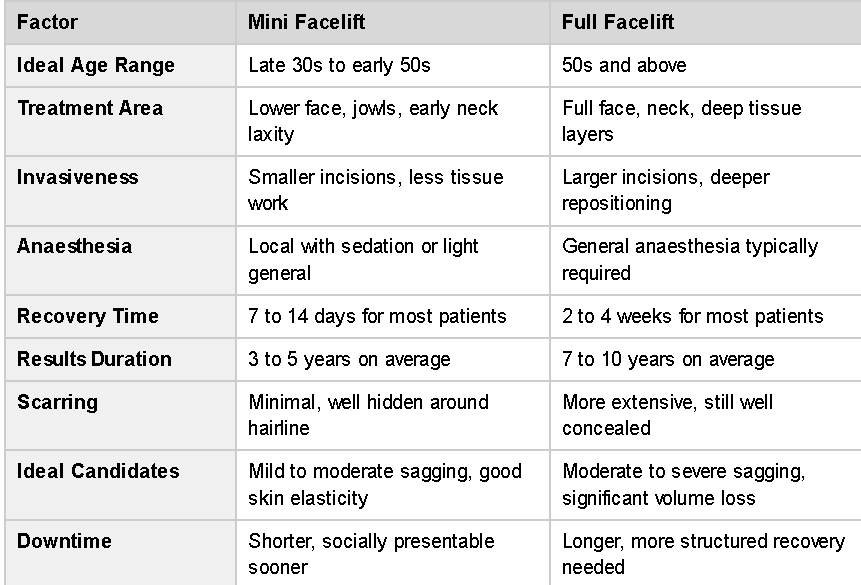
Mini Facelift vs Full Facelift: Side-by-Side Comparison
Who Is a Good Candidate for a Mini Facelift?
A mini facelift works best for patients who are catching their aging concerns early. You may be a suitable candidate if you have:
• Mild to moderate jowling along the jawline
• Early skin laxity in the cheeks or lower face
• Good overall skin elasticity
• Minimal neck sagging or excess skin
• A desire for natural, subtle improvement
• Limited time for recovery due to work or family commitments
Age is not the only factor, but most mini facelift patients are in their late 30s to early 50s. If your sagging is significant or you have lost substantial facial volume, a full facelift may be the more appropriate option.
Who Is a Good Candidate for a Full Facelift?
A full facelift suits patients with more advanced aging concerns. You may be a good candidate if you have:
• Moderate to severe sagging across the face and neck
• Deep folds or creases around the nose and mouth
• Significant jowling that has changed the shape of your face
• Loose or excess neck skin
• Lost facial volume causing a gaunt or hollow appearance
• Realistic expectations and the ability to take adequate recovery time
Full facelift candidates are typically in their 50s and above, though the right age varies widely by individual. Good overall health and non-smoking status improve both safety and healing outcomes.
Which Procedure Gives More Dramatic Results?
A full facelift consistently produces more dramatic and longer-lasting results. It lifts deeper layers of the face, addresses the neck, and corrects more advanced sagging that a mini lift cannot reach.
A mini facelift delivers natural, refreshed results. Patients often describe looking like a younger version of themselves rather than someone who has had obvious surgery. The trade-off is that results are less comprehensive and may not last as long.
Neither procedure is universally better. A mini facelift performed on the right candidate can be just as satisfying as a full facelift on someone with more advanced aging. The goal is matching the procedure to the problem.
Mini Facelift Recovery vs Full Facelift Recovery
Recovery is one of the most important factors patients weigh when comparing these procedures.
Mini Facelift Recovery
• Most swelling and bruising resolves within 7 to 10 days
• Many patients return to light work within one to two weeks
• Strenuous exercise is usually restricted for three to four weeks
• Final results are visible within four to six weeks
Full Facelift Recovery
• Swelling and bruising is more pronounced and lasts two to three weeks
• Most patients take two to four weeks before resuming social activities
• Exercise and physical exertion is restricted for four to six weeks
• Final results settle over three to six months as swelling fully resolves
Both procedures require compression garments, careful wound care, and sun protection during healing. Following your surgeon's aftercare instructions closely makes a meaningful difference to how quickly and smoothly you recover.
Can Non-Surgical Treatments Delay a Facelift?
For some patients, non-surgical options can address early aging concerns and delay the need for surgery by several years. These are not permanent solutions, but they can be effective at the right stage.
Dermal Fillers
Fillers restore lost facial volume and soften deep folds. They work well for patients who are not yet ready for surgery but want to address hollowing around the cheeks, temples, or under the eyes.
Thread Lifts
A thread lift in Malaysia uses dissolvable threads to lift and support sagging tissue without surgery. Results typically last one to two years and suit patients with mild laxity who want a non-surgical option.
Skin Tightening Treatments
Energy-based devices such as radiofrequency and ultrasound treatments stimulate collagen production and tighten skin gradually. They work best as maintenance or for early-stage laxity rather than as replacements for surgical lifting.
Collagen Stimulators
Injectables like Sculptra stimulate the body to produce its own collagen over time. They improve skin quality and restore subtle volume, which can complement or delay more invasive procedures.
At an aesthetic clinic in Kuala Lumpur, your surgeon can assess whether non-surgical treatments are appropriate for your current level of aging or whether a surgical approach will give you more meaningful results.
How to Choose the Right Facelift Procedure
The decision between a mini facelift and a full facelift comes down to a few key questions.
• How significant is your sagging? Mild concerns suit a mini lift. Advanced sagging needs a full facelift.
• What areas concern you most? If the neck is a major issue, a full facelift addresses it more comprehensively.
• How much recovery time can you take? A mini facelift offers faster return to normal life.
• What are your long-term goals? If you want results that last a decade, a full facelift offers greater longevity.
• What does your surgeon recommend? A thorough in-person assessment is the most reliable guide.
No online guide can replace a personalised consultation. A qualified surgeon will assess your facial anatomy, skin quality, and goals before recommending the most appropriate procedure. Book a facelift consultation in Malaysia to get a clear recommendation based on your individual needs.
Frequently Asked Questions
What age is best for a mini facelift?
Most mini facelift patients are in their late 30s to early 50s, when sagging is mild to moderate and skin elasticity is still good. That said, age alone does not determine suitability. Your surgeon will assess your facial anatomy and the degree of laxity present rather than going by age alone.
Does a mini facelift last as long as a full facelift?
No. A mini facelift typically lasts three to five years, while a full facelift can hold results for seven to ten years. The difference comes down to the extent of the procedure. A full facelift repositions deeper facial layers, which leads to more durable outcomes.
Is a mini facelift less painful?
Most patients find a mini facelift more comfortable during recovery because the procedure is less extensive. Discomfort is typically mild to moderate and well managed with prescribed medication. A full facelift involves more tissue work and generally requires a longer pain management period.
Can a mini facelift fix neck sagging?
A mini facelift can address early, mild neck laxity in some patients. However, it is not designed to treat significant neck sagging. If the neck is a primary concern, your surgeon may recommend a full facelift or a dedicated neck lift procedure for better results.
Which facelift has shorter recovery?
A mini facelift has a significantly shorter recovery. Most patients feel presentable socially within one to two weeks. A full facelift typically requires two to four weeks before most patients feel comfortable in public. Both procedures require several more weeks of restricted activity before full recovery.
Is a full facelift worth it?
For patients with moderate to severe facial aging, a full facelift often delivers results that non-surgical treatments and mini lifts simply cannot match. Whether it is worth it depends on your goals, the extent of your aging concerns, and how important lasting, comprehensive results are to you. A consultation with a qualified surgeon will help you weigh that decision clearly.
Can I combine a mini facelift with other procedures?
Yes. Many patients combine a mini facelift with complementary treatments such as eyelid surgery, fat transfer, or skin resurfacing for a more complete result. Your surgeon will advise on what combinations are safe and make sense for your specific goals.
Conclusion
The difference between a mini facelift and a full facelift comes down to the degree of aging you are addressing. A mini facelift suits patients with mild to moderate sagging who want natural improvement and faster recovery. A full facelift suits those with more advanced aging who want comprehensive, long-lasting rejuvenation.
Neither procedure is universally better. The best option is the one that matches your anatomy, your concerns, and your lifestyle. A personalised assessment with a qualified surgeon is the most reliable way to find that answer.
If you are ready to explore your options, speak with the team at Dr. Soma Plastic Surgery in Malaysia to understand which procedure is right for you.