
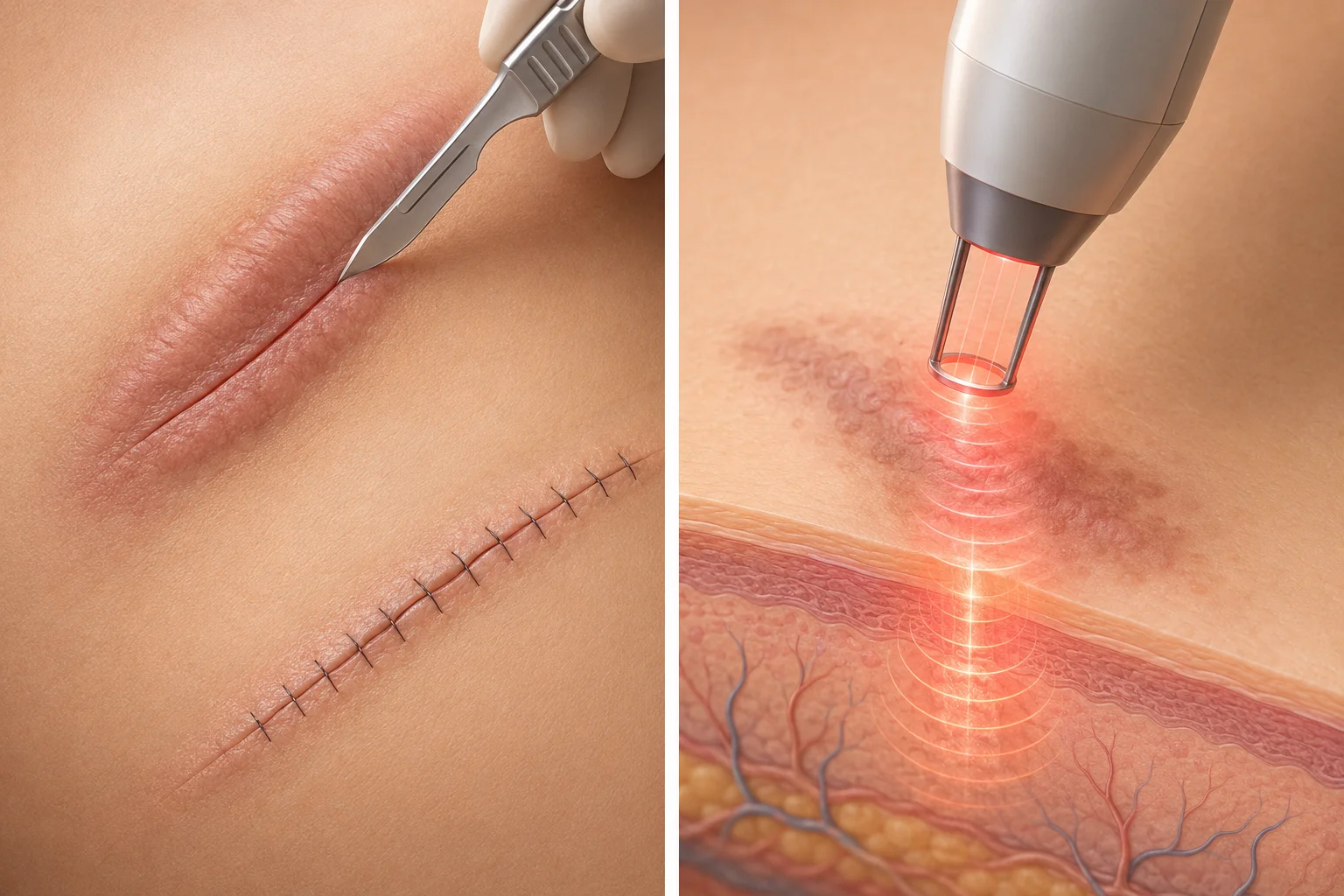
Scars, regardless of their origin (surgery, trauma, burns, or acne), can differ significantly in terms of their appearance, texture, and responsiveness to treatment. Scar revision surgery and laser scar treatment are two popular options in addressing the aesthetic problems caused by scars. Patients often do not know which option relates to their individual case.
Here you will find information about both options, their effectiveness for various kinds of scars, and criteria used by doctors to choose one treatment method over another. As usual, a personal evaluation of an individual patient's scar is necessary to choose the best option.
Why Scar Treatment Isn't One-Size-Fits-All
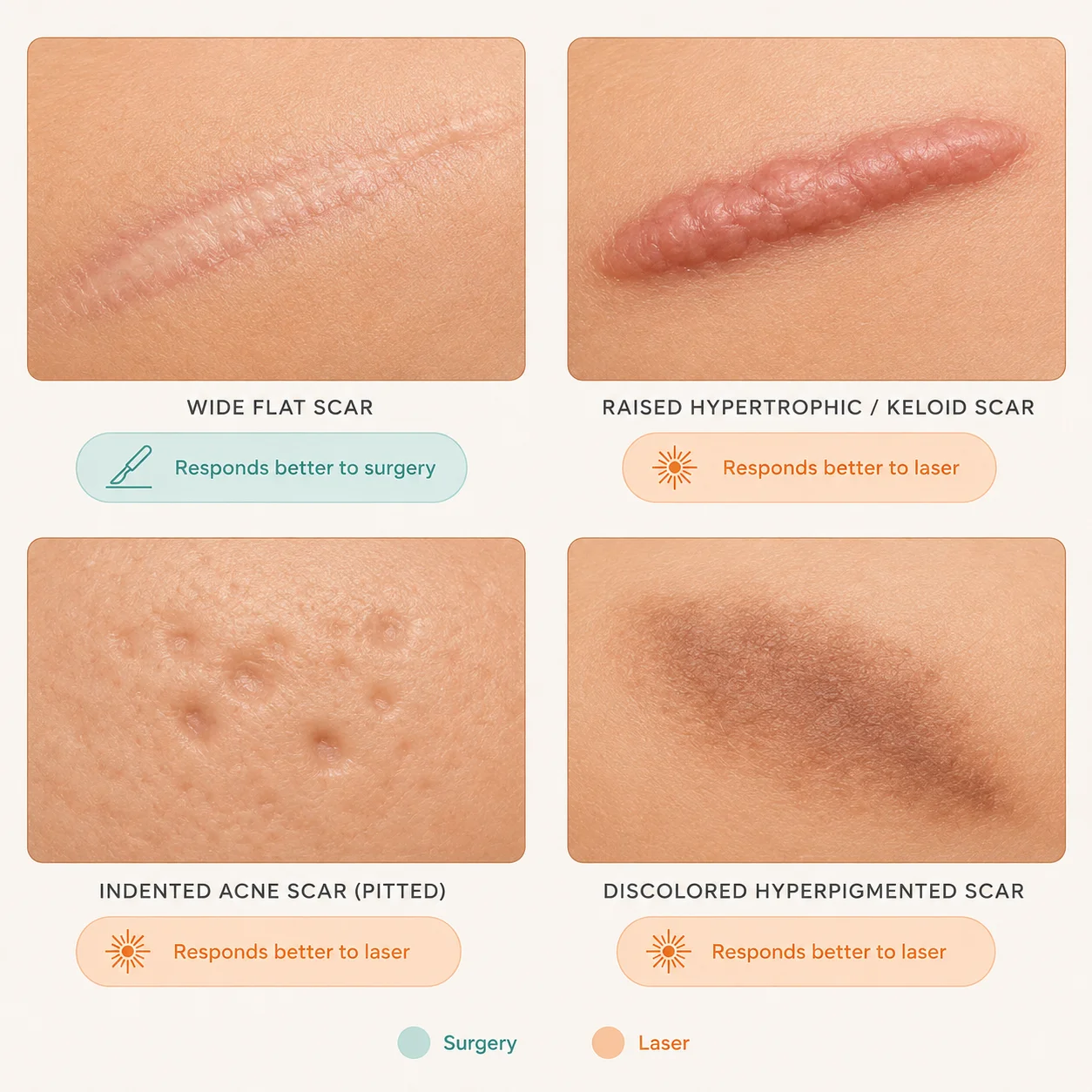
However, the treatment options vary considerably, based on the type of scar, its age, depth, and the original nature of the wound that caused the scar in the first place. An elevated keloid scar acts quite differently from a flat, hyperpigmented scar, which is in turn different from an indented acne scar. In fact, it is precisely because of all this variation that there is no universal best treatment for scars, but rather a treatment plan dependent on the individual scar.
What Scar Revision Surgery Involves
Scar revision surgery is a surgical procedure that physically removes and/or remodels the existing scar, replacing an existing larger or awkwardly placed scar with a better, smaller one or placing it along a natural skin fold where it becomes much less conspicuous.
Scar revision surgery:
-
Physically removes the existing scar and closes the wound through surgery
-
May move the placement of the scar into a more natural skin fold
-
Used for wide, elevated, indented, or awkwardly placed scars
-
Has its own healing process during which a new scar develops
What Laser Scar Treatment Involves
The process of laser scar treatment makes use of light to enhance the texture, color, or even thickness of the scar without physically excising the scar tissue.
Some of the important features of laser scar treatment include the following:
-
It is non-surgical, and the light works on the skin above the scar as well as below the scar tissue
-
It can help to treat redness, discoloration, and irregular texture of the scar
-
Usually needs a number of sessions to achieve effective results
-
Is not associated with much downtime compared to surgery
|
Factor |
Scar Revision Surgery |
Laser Scar Treatment |
|
Approach |
Surgical removal or restructuring |
Non-surgical, light-based |
|
Best for |
Wide, raised, indented, or poorly positioned scars |
Surface texture, redness, and mild discolouration |
|
Number of sessions |
Typically a single procedure |
Often a series of multiple sessions |
|
Downtime |
Generally longer, given surgical healing |
Generally shorter, though varies by technology used |
|
Addresses scar position |
Yes, can reposition along natural lines |
No, works with the scar's existing position |
|
New scar formed |
Yes, ideally more refined than the original |
No new scar, works with existing tissue |
Which Scar Types Suit Surgery
Scar revision surgery is generally recommended when:
-
Wide scars or hypertrophic scars have not responded to other forms of treatment
-
Scars lie along natural skin tension lines and repositioning would make the scar less prominent
-
Indented scars that benefit from restructuring through surgery
-
Functional problems with the scar, like limited movement, besides cosmetic problems
Types of Scars Suitable for Laser Resurfacing
Laser resurfacing for scars is usually recommended when:
-
There is some degree of redness or pigmentation problem, rather than texture problems
-
Textural problems, for instance mild textural problems like those associated with some acne scars and surgical scars
-
The location of the scar and the general size are satisfactory but the surface needs improvement
-
Patients do not want any form of surgery or have tried to avoid surgery by other means
When Both Approaches Are Used Together
Combining scar revision surgery and laser treatment is a common approach and tends to be more effective if done in a staged manner rather than simultaneously. The surgeon can first perform scar revision surgery to correct the scar in terms of its structure and placement and then, once healed, employ laser treatment to improve the color and texture of the scar. Using both treatments together in a staged way may produce better results than using each one separately.
How Surgeons Approach the Decision in Practice
In terms of the factors that should be considered during the evaluation of a scar, during the scar consultation, the surgeon typically evaluates several elements:
-
The way the scar developed - there are many different kinds of scars, such as surgical, injury, and burn scars, and even though they may look alike, their properties can vary
-
When the scar developed - scars that are relatively young tend to evolve, whereas older scars are not expected to change significantly and require some kind of treatment to be improved
-
If the issue lies in the structure of the scar or is superficial - for example, a scar that has an incorrect shape, width, and/or location can only be corrected surgically
Recovery Differences
Typically, a scar revision surgery will have a healing process that includes:
-
The time taken by the scar to heal like any other surgical cut and with limited physical activities
-
Reduction of the appearance of the scar within a few months to one year
-
Follow-ups to check the rate of healing
Typical recovery from laser therapy for scars includes:
-
Slight reddening or slight swelling of the area that has been treated during each session
-
Several sessions conducted several weeks apart, thus increasing the total duration it takes to treat the scar despite minimal down-time after each treatment
-
Improvement seen over the entire treatment period
Realistic Expectations for Either Approach
Both the procedures seek to enhance the look of the scar and not to remove it completely. Scar revision surgery involves creating a new scar that is expected to be more appealing compared to the previous one, but the formation of scars will not be totally eliminated. Laser treatment can offer an effective solution for improving the color and texture of the scar, but the major problems associated with structural changes such as wide and deep scars are usually not solved by laser treatments.
Malaysian Patient Considerations
Skin color and appearance of the scar The multiethnic population of Malaysia has different natural skin colors, and scar appearance such as redness or changes in pigmentation will be variable based on the type of skin that one has. It should be considered when conducting the consultation because some types of laser treatments should have their settings adjusted depending on the skin tone.
Proper sun protection while undergoing laser treatment The constant strong sun radiation in Malaysia necessitates strict adherence to proper sun protection when one is undergoing laser treatment for scars.
The effect of climate on the wound healing process The warm and humid environment in Malaysia may affect the healing of the surgical wounds after the scar revision procedure.
Risks and Safety Considerations
There are some risks related to scar revision surgery. Those may include the risks of general surgery such as infection, bleeding, reaction to anesthesia, and there is always a risk that the newly formed scar will not form as expected. The risks of laser treatment of scars are less severe because they do not involve surgery; however, risks still exist like temporary redness of the skin, pigmentation changes, especially with some skin colors, and the need to have realistic expectations regarding the number of sessions needed to see the results.
Cost Factors to Understand
Scar revision surgery is done once with the cost associated with it; laser scar treatment will cost differently depending on the number of sessions needed. To find out the exact cost associated with scar treatment, you need to visit us in person for consultation.
Conclusion
It is true that scar revision surgery and laser scar revision surgery are completely different treatments for treating scars. While scar revision involves restructuring the scar surgically, laser scar treatment involves improving the look of the scar by making the scar smoother without requiring any cut. In many cases, it works well when the two treatments are used in combination. The best way to find out what suits you best is to take a consultation.
Frequently Asked Questions
Can laser treatment fix a raised, wide scar?
While lasers do improve the appearance of scarring, the width or the raised nature of the scar may respond better to scar revision surgery, possibly followed by laser therapy afterwards to improve the healing results even further.
How many laser sessions will I need?
It really depends on the scar itself and the treatment required, but most laser scars treatment usually entails several sessions conducted at intervals of weeks between each session rather than one session alone.
Will scar revision surgery leave a new scar?
Yes, being a surgical procedure, a new scar will indeed develop, although it should ideally be better and more correctly placed than the initial scar.
Can these two treatments be combined?
Yes, this is one possible course of action when dealing with a scar that needs improvement, and includes conducting the surgery first followed by the laser treatment once healed.
Is laser scar treatment safe for all skin tones?
Lasers require fine-tuned settings according to the skin color to provide safe and successful treatment, which is why a professional who is familiar with different skin types is important, especially in Malaysia.
Which option is better for acne scarring specifically?
This would be determined by the specific kind of acne scarring that one is suffering from. In case of textural or indented acne scarring, it may involve a combination of different forms of treatment including lasers among others.